February the month of Love and the Magic of Courting Flutes @ Institute for American Indian Studies February 15, 2020

February is often called the month of love – a time for Valentine’s Day and, the time to remember and emphasize the importance of love in our lives. In Native American culture the mind, the spirit, the love of one’s roots, the love of nature, and of others is ingrained culturally. Stories are one way of communicating the love of nature and of life and courting flutes are another way of expressing feelings of love and the appreciation of the beauty of nature.

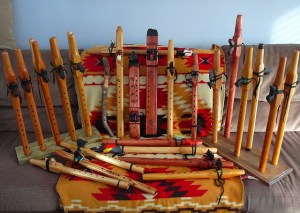
The Institute of American Indian Studies on 38 Curtis Road in Washington has organized a program on the magic of courting flutes that allows visitors to delve into traditional Native American Music. It is a wonderful way to top off Valentine’s Day week. On Saturday, February 15, beginning at 1:30 p.m. Ojibway artist, and musician Allan Madahbee will explain the cultural significance and the hauntingly beautiful sound of the Native American courting flute. The legend of the courting flute will be told highlighting these beautifully made instruments that are deeply rooted in the traditions of Eastern Woodland indigenous peoples. Participants will see and hear a variety of courting flutes and will have the chance to examine them as they listen to their soothing sound. Courting flutes are available in our gift shop and there will be a limited selection of courting flutes available for purchase on the day of this event. If you already own a flute, feel free to bring it along!
About Allan Madahbee

Today, makers of Native American Flutes like Ojibway artist and musician AllanMadahbee craft their personal style and sound into their creations. Madahbee began to research the Chippewa flute culture and was influenced and mentored by Joseph Firecrow of the Cheyenne Nation. “We became friends and he provided guidance and feedback and explained some of his methods of flute making. With his passing last year, we have all lost a great Native American flute maker and musician. I am proud to continue our flute making traditions.” The sound of the courting flute that is usually made of cedar has an uncommon scale for Western music and is entrancing.
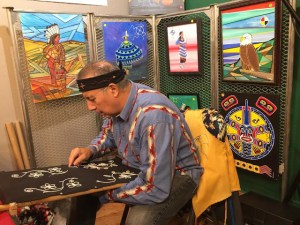
Born on the shores of Lake Huron, Allan Madahbee is a member of the Ojibway (Chippewa) Nation that has pursued the traditional arts and crafts of his ancestors. He has been making Native American flutes for about ten years. “I had always thought they were a product of the Southwest Indian tribes, but a book that I found that was written during the 1800s about Chippewa culture, had a passage about the Chippewa flutes, along with pictures. This made me realize that they were indeed a part of my Chippewa culture. Knowing that my ancestors constructed these flutes for hundreds of years has inspired me to continue this tradition. Also, the haunting sound from these mystical instruments is a large part of my inspiration.”

Along with constructing Woodland flutes, beaded moccasins, woodcarvings, Native American regalia, and rock sculptures, Madahbee always returns to his artistic roots in paintings and weavings. Mainly self-taught, Madahbee attended school with fellow Ojibway artists Blake Debassige and James Simon – two well known Anishnawbe artists that are respected and have their paintings displayed around the world.

Space is limited and reservations are suggested. To make sure you get a spot call the Institute for American IndianStudies at (860) 868-0518 or email general@iaismuseum.org to reserve your spot. The program is included in the price of admission: $10 adults; $8 seniors; $6 children; IAIS Members free.

About The Institute for American Indian Studies
Located on 15 acres of woodland acres the Institute For American Indian Studies preserves and educates through archeology, research, exhibitions, and programs. They have the 16th c. Algonquian Village, Award-Winning Wigwam Escape, and a museum with temporary and permanent displays of authentic artifacts from prehistory to the present that allows visitors to foster a new understanding of the world and the history and culture of Native Americans. The Institute for American Indian Studies is located on 38 Curtis Road, Washington, CT.
Two Programs @ White Memorial Foundation in February

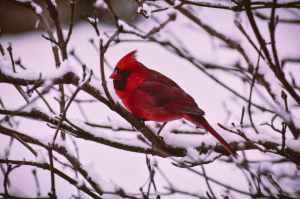
White Memorial Foundation in Litchfield is hosting two very interesting programs this week that is sure to chase away the winter blues. The first program takes place on February 11 from 9 am – 11 am with a focus on instinctive birding. Join birder Kristi Dranginis (founder of Bird Mentor: http://www.BirdMentor.com) on the second Tuesday of each month for a golden opportunity to dive deep into the practice of Instinctive Birding. Winter is a wonderful time to participate in this nearly lost art. Learn to interpret the subtle signs and voices of the birds while also becoming more proficient with your bird ID skills.

You will begin observing the unfolding story of the landscape with a bird sit. Please bring something to sit on (camp chair, cushion, etc) and a blanket to keep you warm if you like. Minty hot cocoa will be provided, so bring your mug. We’ll then transition inside where we’ll warm up and peel away the layers of the mysteries that presented themselves to us during our sit. The sessions will average about 2 hours, but feel free to head out whenever you need to. Open to all experience levels. Dress for the weather! Will take place snow or shine! Head on over to www.birdmentor.com/birdwalk

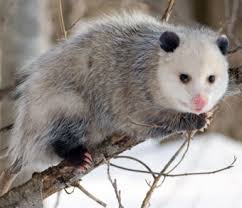
The second program takes place on February 15 and begins at 2 p.m. Participants will meet Lavender the Virginia Opossum and her friends Pam and Bill Lefferts from Ferncroft Wildlife Rehabilitation in Woodstock! There is a wonderfully interesting reason why the Lefferts chose this day for their program celebrating this most misunderstood mammal! Learn fascinating fun facts about North America’s only marsupial during a one-hour presentation that will also address the rescue center’s work in wildlife rehabilitation and how you can make your backyard into a wildlife sanctuary.

And, if you have children ages 12 and under, February 16-22 is museum children free week when accompanied by an adult.

Let the Good Times Roll at The Carousel Museum! Feb. 22!

The New England Carousel Museum will be in full New Orleans style celebration mode during our 30th annual Mardi Gras party on Saturday, February 22, 2020 from 7:30 PM – midnight. Come join us for an evening of fun and frolicking with great music, good food, bourbon, and beads.

The Big Easy evening features music and dancing by Nate Evans of Hartford Ballroom along with a 50/50 raffle and live entertainment that will include face painters, temporary tattoos, bourbon and wine tastings in the Speakeasy, beads and doubloons, and a catered dinner! This is a BYOB event. Attendees are encouraged to wear an optional mask or come in full costume. Masks are available to purchase in the museum gift shop.

The evening’s festivities will culminate in the crowning of a king and queen of the ball.

Interested in more information or donating to our Silent Auction? Please call Cassandra Lavoie @ 860-585-5411 x 103 or manager@thecarouselmuseum.org

Human Dog Sled Race Just One Highlight of the Salisbury JumpFest Friday, Feb. 7-Sunday, Feb. 9, 2020

Are you up for some quirky winter fun? Get a group of your friends together to enter JumpFest’s Human Dogsled Race! This unusual winter event is part of the 94th annual Ski Jumping Championships in Salisbury, Connecticut taking place on Friday, February 7, Saturday, February 8, and Sunday, February 9.

The human dogsled team consists of six people, five pulling, and one rider. It is so much fun to watch these colorful sleds and costumed teams race against one another! The teams compete in timed, two teamed races, and the two fastest times in the men, women, and mixed categories run a second race. Trophies are awarded to the three fastest teams in each category. There is also a people’s choice trophy for the most unusual sled and costumes.

The Human Dogsled Competition takes place on Friday, February 7 around 9 p.m. after the ski jumps for the evening are over. The registration fee is only $25 (paid on February 7 at the event) and all human dogsled participants get into Jumpfest free! For detailed information http://www.jumpfest.org. To download the registration form click here.
The registration fee helps SWSA, a non-profit volunteer organization to continue to foster the sport of ski jumping and the Eastern National Ski Jumping Championship.

Festival Schedule
JumpFest kicks off on Friday, February 7 at 6 p.m. with Target Jumping beginning at 7 p.m. Target Jumping is followed by the infamously fun Human Dog Sled Race, a crowd favorite that begins between 8:30 p.m. and 9 p.m. Teams of six participate, five pulling the sled and one riding. The sleds and costumes, of course, boggle the imagination! Trophies are awarded for the best in men’s women’s, mixed categories. Competitors navigate a .3-mile course through the snow. It’s all in fun, and teams can get very creative with both their costumes and sleds. Two large bonfires and warm food and beverages are available.

On Saturday, February 8, things warm up with a Junior Meet that is followed by the practice of participating jumpers from 11 a.m. to 12 noon. The main competition begins at 1 p.m. It is thrilling to watch these Olympians in the making defy gravity and soar through the air with runs of up to 200 feet. Another tradition is the Snow Ball Dance taking place at the White Hart Inn with entertainment by the Steve Dunn Band. This is the perfect time to mingle with fellow sports lovers, bid at the silent auction, and take a chance on a raffle ticket that benefits the Salisbury Winter Sports Associations (SWSA) programs. The admission to the Snow Ball Dance is $15. The highly anticipated Eastern U.S. Ski Jumping Championships on Sunday, February 9 begins with practice at 11 a.m.; the competition begins at 1 pm. At this event, there are often Olympic hopefuls that display the tremendous coordination, skill, and grace that have what it takes to soar so far and so high with a smooth and successful landing. Make ski jumping history and be there to see if the Salisbury record is broken – perhaps a new contender for the Olympics! Even the most sedentary spectators will appreciate the extraordinary coordination and skill required to make this jump! Judging from past history, some of the competitors here will go on to the Olympics.

Coffee, hot chocolate, wine, beer, hot toddies and food will be available at all events. As this is an outdoor event, and it is winter, please dress warm – don’t forget your cowbell and cellphone for great photo opportunities! On Friday, February 7, the event ticket booth opens at 6 p.m. and admission is $15; on Saturday, February 8, the event opens at 10 a.m. and tickets are $15, on February 9 the event opens at 11 a.m. and tickets are $15. The Snow Ball Dance is $15 at the door. The Human Dog Sled Race entry is $25 on Friday, February 7 with the downloaded pdf.

About Salisbury Winter Sports Association (SWSA)

It all began in 1926 when a gentleman named John Satre (Say-tree) showed off the sport he had learned in his native Norway with the unlikely feat of jumping from the roof of a shed while wearing skis. To everyone’s surprise, instead of crashing Satre soared through the air and glided to earth. It looked like fun and by the next summer, several neighbors had gotten together to begin building a proper takeoff and ski run. A former cow pasture became the landing area. On January 29, 1927, the club, the Salisbury Winter Sports Association (SWSA) held its first competition with a crowd of more than 200 spectators. This all-volunteer group has hosted several National Championships and, today continues to maintain Satre Hill, introduces young and old to the sport of ski jumping, and organizes the competitions.

Native American Winter Survival Techniques Feb. 1 @ Institute for American Indian Studies

Modern resources, gadgets, apps, and technology – we all use them to make our lives easier. But what if we didn’t have all of them to rely on? Native American communities living in Connecticut managed to live quite comfortably through the harsh New England winter. They spent the summer and fall preparing, storing, and foraging for winter by using a multitude of natural resources that are key to surviving in the winter.

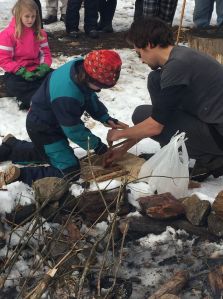
on Saturday, February 1 beginning at 1 p.m. join museum educator, Griffin Kalin from the Institute for American Indian Studies to learn how to find shelter, make food, and stay warm when the weather is cold and your resources are diminished. An unusual highlight will be a demonstration of how to tan a hide in order to make leather for clothing. This program on how to survive in the Eastern Woodlands without twenty-first-century technology is fun, informative and thought-provoking. Best of all, the Winter Survival program is free with the price of a modest admission – adults $10, seniors, $8 and children $6.

Participants will learn how to start a fire in the snow, how to find food in the forest, and how to make a shelter from the natural environment. This is an immersive experience for program participants because they will actually visit the 16th century replicated Algonkian village on the grounds of the Institute that is composed of several wigwams, a longhouse, a fire circle, drying racks, and the dormant three sisters garden cultivated every summer by the museum.

It is exciting as well as an engaging experience that is suitable for all ages. The experience will make you feel as though you have stepped back in time as you explore the forest and learn the ways of the Eastern Woodland Indians.

To participate in this event be sure to dress warm and wear appropriate footwear because some of this program will be outside. In addition to this program, entrance to the museum with its fascinating exhibits and wonderful gift shop featuring locally made handcrafted Native American art, crafts, and jewelry among other items is also included.

About The Institute for American Indian Studies
Located on 15 acres of woodland acres the Institute For American Indian Studies preserves and educates through archeology, research, exhibitions, and programs. They have the 16th c. Algonquian Village, Award-Winning Wigwam Escape, and a museum with temporary and permanent displays of authentic artifacts from prehistory to the present that allows visitors to foster a new understanding of the world and the history and culture of Native Americans. The Institute for American Indian Studies is located on 38 Curtis Road, Washington, CT.

Watch Future Olympians Soar in Salisbury’s 94th Annual JumpFest February 7,8, and 9, 2020

This will be the 94th year when ski jumpers and lovers of winter sports converge in Salisbury at Connecticut’s signature winter event, JumpFest. Ski jumping was introduced to this bucolic town in 1926 when a Norwegian farmer, Mr. Satre sailed off his barn; making ski jumping a winter tradition here ever since. This year, JumpFest is taking place on February 7, 8, and 9, 2020, at Satre Hill on Indian Cave Road in Salisbury. For updates and more information click here or info@jumpfest.org or www.jumpfest.org.

There are only a half a dozen ski jump facilities on the East Coast, with JumpFest being the southernmost location. Some of the best athletes will be here competing in an event that has launched many Olympians. As a matter of fact, three of the four men that participated in the Olympics at Sochi had something in common, they were all from the east coast, and they all participated at JumpFest.

For the Tri-State area and beyond, JumpFest offers a very special opportunity to watch these graceful athletes fly through the air — up close! The anticipation of watching competitors travel up to 200 feet through the air at more than fifty miles an hour and, guessing who is the fastest — and highest in real-time — is an unforgettable experience. It is so much fun to be part of the excitement! The crowds’ ring cowbells to cheer on their favorites and the jumpers take notice. The excitement reaches a crescendo when the slap of skis hits snow in a smooth landing with everyone hoping that this jump beats the Salisbury record, an impressive 231-foot jump.

Festival Schedule
JumpFest kicks off on Friday, February 7 at 6 p.m. with Target Jumping beginning at 7 p.m. Target Jumping is followed by the infamously fun Human Dog Sled Race, a crowd favorite that begins between 8:30 p.m. and 9 p.m. Teams of six participate, five pulling the sled and one riding. The sleds and costumes, of course, boggle the imagination! Trophies are awarded for the best in men’s women’s, mixed categories. Competitors navigate a .3-mile course through the snow. It’s all in fun, and teams can get very creative with both their costumes and sleds. Two large bonfires and warm food and beverages are available.

On Saturday, February 8, things warm up with a Junior Meet that is followed by the practice of participating jumpers from 11 a.m. to 12 noon. The Junior 20 to 30-meter competition begins at 1 p.m. It is thrilling to watch these Olympians in the making defy gravity and soar through the air with runs of 65 to 98 feet. Another tradition is the Snow Ball Dance taking place at the White Hart Inn with entertainment by the Steve Dunn Band. This is the perfect time to mingle with fellow sports lovers, bid at the silent auction, and take a chance on a raffle ticket that benefits the Salisbury Winter Sports Associations (SWSA) programs. The admission to the Snow Ball Dance is $15. The highly anticipated Eastern U.S. Ski Jumping Championships on Sunday, February 9 begins with practice at 11 a.m.; the competition begins at 1 pm. At this event, there are often Olympic hopefuls that display the tremendous coordination, skill, and grace that have what it takes to soar so far and so high with a smooth and successful landing. Make ski jumping history and be there to see if the Salisbury record is broken – perhaps a new contender for the Olympics! Even the most sedentary spectators will appreciate the extraordinary coordination and skill required to make this jump! Judging from past history, some of the competitors here will go on to the Olympics.

Details and More
Coffee, food, and hot chocolate will be available at all events. As this is an outdoor event, and it is winter, please dress warm – don’t forget your cowbell and cellphone for great photo opportunities! On Friday, February 7, the event ticket booth opens at 6 p.m. and admission is $15; on Saturday, February 8, the event opens at 10 a.m. and tickets are $15, on February 9 the event opens at 11 a.m. and tickets are $15. The Snow Ball Dance is $15 at the door. The Human Dog Sled Race entry is $25 on Friday, February 7 with the downloaded pdf.

Between events, there will be plenty of time to explore the charming town of Salisbury with its many intriguing shops and restaurants all within walking distance of Jumpfest. A highlight is an art show, The Wonders of Winter hosted by the Salisbury Association that includes art by 34 national and international artists showcasing sixty works of art in six locations including William Pitt/Sotheby’s International Realty, Sweet William’s Coffee Shop & Bakery and the White Hart Inn, all within walking distance of each other on Main Street, Salisbury. Many of the paintings are on sale with a portion of the profits going to the Salisbury Winter Sports Association youth skiing programs and ongoing facility improvement.

About Salisbury Winter Sports Association (SWSA)

It all began in 1926, when a gentleman named John Satre (Say-tree) showed off the sport he had learned in his native Norway with the unlikely feat of jumping from the roof of a shed while wearing skis. To everyone’s surprise, instead of crashing Satre soared through the air and glided to earth. It looked like fun and by the next summer, several neighbors had gotten together to begin building a proper takeoff and ski run. A former cow pasture became the landing area. On January 29, 1927, the club, the Salisbury Winter Sports Association (SWSA) held its first competition with a crowd of more than 200 spectators. This all-volunteer group has hosted several National Championships and, today continues to maintain Satre Hill, introduces young and old to the sport of ski jumping, and organizes the competitions.