Maple Sugaring Legend – The Iroquois and the Fiesty Red Squirrels

March is a month of transition between winter and spring. It is also the time when maple trees produce sap that can be boiled down to make maple sugar. Native American communities called the full moon in March the worm moon because this was the time when worms came out of the ground and robins started to reappear. Another name for the moon in March is the Sap Moon because this is when the sap from maple trees begins to flow.

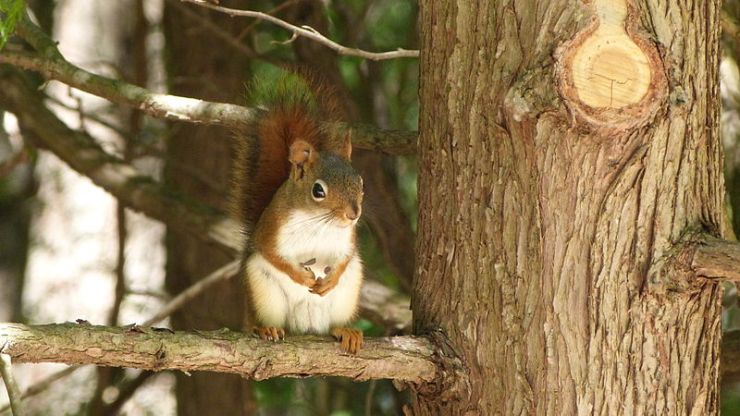
There is an Iroquois folktale that explains that Native Americans initially observed a red squirrel cutting into the tree bark with its teeth and later returning to lick the sap. An Iroquois youth observed this behavior and decided to use his knife to cut into the bark of a tree…thus discovering the maple tree’s sweet secret. ​

In a study in the 1990s, scientists observed red squirrels making chisel-like grooves in the bark of a maple tree. After making the grooves in the tree, the squirrels left the tree! They returned to the tree about 24 hours later and licked up the sap that remained on the tree. By this time the water in the sap had evaporated leaving behind a high concentration of maple sugar!

Don’t miss the Maple Sugar Festival at the Insititute for American Indian Studies on March 14 from 11 am – 3 pm. The Institute is located on 38 Curtis Road in Washington CT.

About The Institute for American Indian Studies

Located on 15 acres of woodland acres the Institute For American Indian Studies preserves and educates through archeology, research, exhibitions, and programs. They have the 16th c. Algonquian Village, Award-Winning Wigwam Escape, and a museum with temporary and permanent displays of authentic artifacts from prehistory to the present that allows visitors to foster a new understanding of the world and the history and culture of Native Americans. The Institute for American Indian Studies is located on 38 Curtis Road, Washington, CT.
Weave through history @ Glebe House in Woodbury

The Glebe House Museum will continue its “Colonial Life Series” focusing on the Colonial Life of Women. This series is presented with the help of a grant received from the “Women’s Giving Circle of the Connecticut Community Foundation”. The Colonial Life Series was designed to present the “lost” arts of colonial life, in an intimate setting, at our historic site. Immerse yourself in history in these programs based on the important contributions of women during the colonial period that affected not only their immediate household but their local community and beyond.

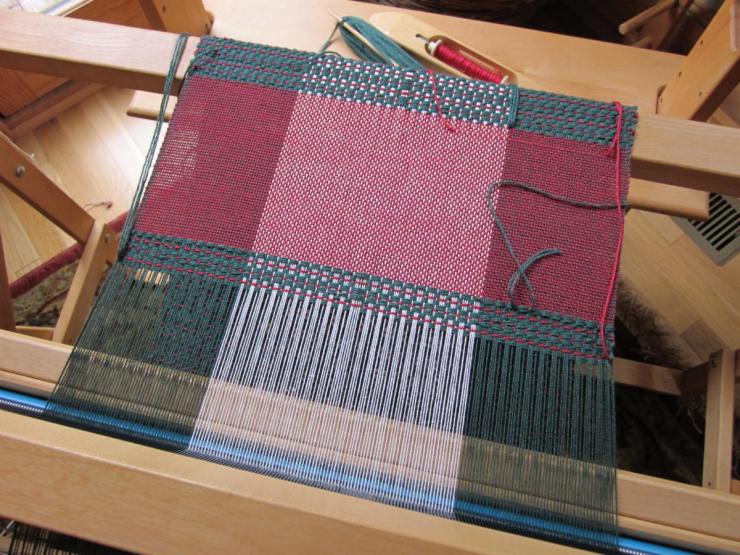
Weaving Thru History
Saturday, March 14 @ 12:00 pm

Weaving was already an ancient art in the colonial era, but how did it evolve and what were the advancements made by the 18th century that allowed colonial women to provide their families with linens & clothing. Join Glebe Director, LoriAnn Witte, for this presentation about the history of weaving and its effect on the production of necessities, decorative arts and fashion.
This program will be presented in the “kitchen” of the Glebe House Museum (c.1750), immersed in colonial artifacts and history. Light refreshments will be served.

Class Fee: $20 each for members – $25 each for non-members
*Registration is Required / Limited Seating
Call 203-263-2855 or office@glebehousemuseum.org

Over & Under: The Art of Weaving
Sunday, March 22 @ 1:00 pm

Have you ever wanted to learn how to weave, but find all of the available information complicated and the supplies pricey? Then this is the workshop for you! Participants will learn how to make a simple loom and the techniques for set up and basic weaving to get started. Glebe Director, LoriAnn Witte, will share her knowledge of 25+ years of weaving in technique and tools of the trade. Join us for this hands-on workshop presented in the “kitchen” of the Glebe House Museum (c.1750), immersed in colonial artifacts and history. Light refreshments will be served.
* Please contact Museum Director for information about Materials Fee.

Class Fee: $20 each for members – $25 each for non-members
Materials Fee: Please contact Museum Director.

Registration is required / Limited seating.
Call 203-263-2855 or office@glebehousemuseum.org

Sign up for both programs and receive a $10 discount.
All proceeds benefit the Glebe House Museum.

For more information about these programs, please visit our website at www.glebehousemuseum.org
To register please contact the Museum Office at 203-263-2855 or by email at office@glebehousemuseum.org.

Syrup Saturday: A Pancakes & PJs Party March 14

Bring the whole family to the New Canaan Nature Center to join them for their annual end of syrup season celebration – you won’t want to miss our famously delicious Pancakes & PJs party, complete with TONS of fun syrup-related activities! We’ll be serving up flapjacks, syrup, and an array of tasty toppings in the Visitor Center, while leading tree tapping demos, a real maple sap “boil down,” campfire with marshmallows, and a real v. fake syrup taste test.

In fine syruping tradition, we’ll also have bottles of NCNC Maple Syrup for sale in our Nature Gift Shop!

All are welcome and encouraged to dress in their PJs!

While this event’s pancakes & PJs party is indoors, all other activities take place outdoors.

General Admission

Members: $8/person
Non-Members: $10/person

VIP Lounge Dining

Reserve your very own table and unique dining experience in the VIP Lounge of the NCNC Green House! Let our staff wait on you! Enjoy the bounty of our Pancakes & PJ’s Party, PLUS more: sausage, fresh fruit, Nutella, whipped cream, and home-made NCNC maple syrup!

Seating Times: 8:30am or 10:00am

Pre-registration is mandatory as seating is extremely limited. Table prices include admission and all additional Syrup Saturday activities.

Table of 4: $40
Table of 8 $80

A Life in Color – Black History Month @ Sherman Historical Society

The Sherman Historical Society shared the story of Florence Quammie whose abbreviated bio is told in the book, A Life In Color. It is a fascinating look into the early 20th-century history of this charming Connecticut village.

Courtesy A Life in Color and the Sherman Historical Society

It was the year 1933 when the Quammies moved to Sherman, Joseph Allan, his wife Flora Mae and their two children, Florence and Gerald. At the time, Florence was only six years old. The family moved from the Bronx and, they were the first black family to make their home in Sherman. The potential for complications could come into play for this interesting transition. The history for it was certainly there.
During the Civil War and despite abolitionists’ cries, the majority of the North was not fighting for slaves’ rights; in fact, many couldn’t have cared less either way; for them, the fight was about preserving the Union.  During and after it, the influx of freed Blacks moving north to find work in the industrialized cities came up against both American-born and immigrant workers who saw their jobs threatened by the new arrivals.

The book interviews Florence at 80 years old. Her story is refreshing and one that destroys stereotypes and expectations. Her parents came to Sherman to work for the Walter Evans family at “Estwick,” (the stately 1804 Federal Colonial home on the corner of Chapel Hill). “The Evanses treated us like family; they took to my brother and me like their own.” In fact, Florence enjoyed many activities she might not otherwise have known, among them: learning to play tennis and piano and attending numerous concerts and plays.

In the book, a Life of Color, Florence recalls the many wonderful times she had growing up in Sherman. She was accepted by the children of the town in school and made many lasting friendships with no racial barriers. This book is inspiring and shows that tolerance breeds goodness and acceptance breeds community.

A Life in Color is available from the Sherman Historical Society’s Old Store or by contacting them via email office@shermanhistoricalsociety.org

Norwalk Musical One-Woman Show Feb 29

In honor of Black History Month, the Norwalk Historical Society is presenting “A JOURNEY” Musical a one-woman show written and performed by Kimberly Wilson, brings to life seven historical African-American women, including Harriet Tubman, Sojourner Truth, Rosa Parks, and Maya Angelou. The show will take place on Saturday, Feb. 29 at 4 pm.

Through singing and character transformations, this performance takes the audience to a special place with educational and timely messages of perseverance, faith, hope, courage and love.

Ms. Wilson skillfully tells of the struggles and influence of Black womanhood with strength, dignity and pride and in perfect lockstep with the history of the United States.

After each performance, audiences participate in a talk-back which extends the wealth of this theatrical experience.

For tickets click here

The Institute for American Indian Studies Presents…Etuaptmumk- Two-Eyed Seeing February 22

On Saturday, February 22, the Institute of American Indian Studies is hosting a culturally important program on research and sharing in regard to Indigenous People called Etuaptmumk- Two-Eyed Seeing. Etuaptmumk is a Mi’kmaw saying that translates to “Two-Eyed Seeing.” This concept refers to learning how to see from one eye the strengths of Indigenous knowledge and from the other eye the strengths of Western knowledge. The idea of “Two-Eyed Seeing” has been developed by Albert Marshall, an environmental voice and culture keeper for Eskasoni First Nation in Cape Breton.

Join the IAIS Education Coordinator and Traditional Storyteller Darlene Kascak, Schaghticoke Tribal Nation along with IAIS Educator and Ecologist Susan Scherf for an interactive presentation and discussion that examines how people can include Etuaptmumk or “Two-Eyed Seeing” concept in their daily lives. This method of thought and research is a way for Native and Non-Native people to understand one another and to collaborate. Community engagement between the two groups is of paramount importance and leads to authenticity.

This fascinating program strives to share research paradigms and approaches that align with Indigenous worldviews. A trend in the academic world, that many scholars are using Marshall’s Two-Eyed Seeing as a framework to understand and use western methods and theory with indigenous knowledge. When Indigenous people become part of the research rather than those being researched, the results of this research and understanding will be transformed. Questions will be framed differently and priorities will change.

The Etuaptmumk- Two-Eyed Seeing program takes place at 1:30 p.m. on February 22 and is included in the price of admission that is $10 adults, $8 seniors, and $6 children.