Trial of the Century: Nuremberg Trials Lecture at Westport Historical Society

On  Thursday, March 15 from  7 – 8 pm,  Historian Mark Albertson,  joins the Westport Historical Society to recreate November 20, 1945, 10 a.m. In the old fortress prison in Nuremberg, northern Germany, 23 defendants fill the prisoners’ dock in the central courtroom, some of them the elite of Nazi political gangsterdom. The ensuing trials would be an effort to dispense justice in lieu of vindictive retribution. If the world were to have any chance to heal, the Rule of Law would have to prevail. Citing violations of international law such as crimes against humanity, crimes against peace, and war crimes, the Nuremberg judges would create for posterity volumes of evidence, court proceedings, and judgments to serve as a model for post-war humankind as a way to build a better world.
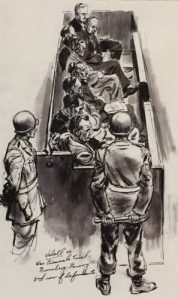
 In the end, Nuremberg produced not the judgment of God or the judgment of history, but humankind’s judgment of its own: an admission that organizations do not start wars or commit atrocities, but people do. And be it a head of state or a lowly military private, nobody should be above the law.

 Mark Albertson is an historical research editor at Army Aviation magazine and the historian for the Army Aviation Association of America. A longtime member of the United States Naval Institute, he has authored several books, including USS Connecticut: Constitution State Battleship, They’ll Have to Follow You!: The Triumph of the Great White Fleet, and On History: A Treatise. Mark is currently at work on another book, Sky Soldiers: The Saga of Army Aviation.

Mark has published numerous articles on issues of history and current events and is an avid speaker on a variety of issues on history. In May 2005, he was presented with a General Assembly Citation by both houses of the Connecticut General Assembly for his efforts in commemorating the centennial of the battleship USS Connecticut. Mark teaches history at Norwalk Community College for the Extended Studies Program and the Lifetime Learners Institute. Learn more at  www.markwriter.com. 

 Nuremberg Trials, Thursday, March 15, 7-8 pm Westport Historical Society 25 Avery Place, across from Town hall. To register, go to westporthistory.org or 203-222-1424. Suggested Admission $10 members, $15 nonmembers. Light refreshments will be served.
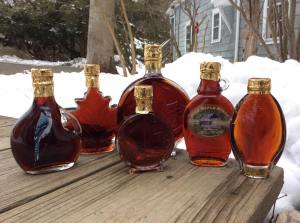
Audubon Sharon hosts MapleFest along with Maple Bake Sale

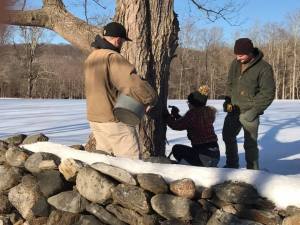
Audubon Sharon will be holding its annual MapleFest on Saturday, March 17 between 12 and 4 pm at the Sharon Audubon Center, Route 4, Sharon, CT. On-going guided 45-minute tours will lead visitors through the Center’s sugaring operation, including a working sugarhouse and a re-creation of Native American and early colonial sugaring methods. Participants can watch as pure sugar maple sap is collected from the trees and turned into delicious maple syrup. Admission for the event is $6.00 adults and $4.00 children (2 and under free.) Wear warm clothes and boots, as much of the tour is outdoors.

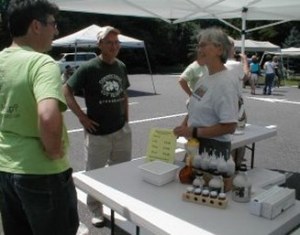
Fresh, homemade maple baked goods and coffee will also be available for purchase during the day as part of the Maple Bake Sale. Each treat will be made with the Center’s very own maple syrup! Fresh syrup will be available for purchase while supplies last, as well as locally made maple candy.

For more information on MapleFest or the Audubon Sharon sugaring operation, contact the Audubon Center at (860) 364-0520, visit www.sharon.audubon.org, or like us on Facebook.

A Duo of Sugar Houses not to be missed!

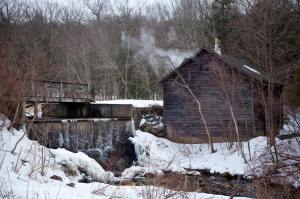
It’s a sweet New England tradition—toasting old man winter out the door with delicious new maple syrup. As soon as days are above freezing and the sap begins to run, the annual spring ritual begins. Turning thin sap into thick, fragrant syrup is a fascinating process and Western Connecticut, where sugar maple trees abound, is one of the best places to see it in action. More than a dozen sugar houses in Fairfield County and the Litchfield Hills invite visitors to see how it is done, from tapping the maple trees to collecting the sap to boiling down the thin watery sap until it turns to the thick, fragrant syrup.


A variety of settings, from farms and nature centers to museums are among the maple possibilities, most offering tastes as well as show and tell, and many have take-home syrup for purchase as a sweet souvenir. The sugaring season starts early at large facilities like Lamothe’s Sugar House in Burlington, where the public is invited to see how syrup is made every weekend through March 30. This family-owned operation began as a hobby with seven taps and has grown to over 4500 taps and a year-round showroom. The showroom is open Mon. – Thurs. 10 a.m. to 6 p.m., and Fri. and Sat. 10 am – 5 pm and Sun. 12 noon to 5 pm.

Their newly expanded shop offers a tempting array of unusual foods like maple mustard and maple apple butter plus original maple-themed items from embroidered aprons, decorating sets, and cupcake-shaped rubber spatulas to a cupcake carrier in the shape of a big cupcake. www.Lamothesugarhouse.com

Brookside Farm II, located in Litchfield CT, is a relatively small and very high-quality maple syrup operation. Mark Harran and Kay Carroll, owners of the farm since 1999, make about 250 gallons of maple syrup per year, depending on weather conditions, which dictate the flow and sugar content of the sap. The owners both had careers in the food industry prior to buying the farm. They have applied all their collective knowledge and experience, along with Mark’s childhood experiences on his family’s large sugar bush in upstate New York, to their operation in Connecticut.

Brookside Farm’s production process yields 100% pure and basically 100% organic maple syrup. Unlike some older sugaring operations, they do not use equipment that contains lead, solder or galvanized metal. Most of the sap is collected with tubing and processed in an evaporator and canning equipment that are 100% stainless steel with tig welds.

Mark and Kay welcome visitors, just call ahead. They like teaching folks of all ages where maple syrup comes from, how it is made and the differences in the four grades of maple syrup. A tour includes a tasting and recipe suggestions. Phone: 860-567-3890.

Maple Syrup Tours @ Sullivan Farm Through March

New Milford’s Sullivan Farm is hosting maple syrup tours running through March. The cost is $5 per participant with chaperones for groups of 10 or more receiving free admission.

In addition to syrup tastings and demonstrations, participants will also learn about processing techniques. Also, the syrup will be available for sale. The tour runs about 45 minutes.

Sullivan Farm is located at 140 Park Lane in New Milford. For more information email vincent@youthagency.org or call 860-210-2030.

Stories in Clay @ Institute for American Indian Studies

Everyone likes a good story. In Native American culture, stories were told to pass on knowledge from generation to generation. It was a way for tribe elders to pass on the history, sacred learning and beliefs to future leaders of the tribe.

In recent years Native American artists have set out on a new updated artistic path using clay to tell the stories of traditional life as a caregiver, mother or father and homemaker. Helen Cordero, a member of the Cochiti Pueblo, located 55 miles from Albuquerque, New Mexico is a perfect example of the new generation of avant-garde Indian clay artists and the Institute of American Indian Studies in Washington, Connecticut has an excellent collection of her work as well as the work of many other famous artists of this genre that have been generously donated to the museum.

This Singing Mother was made by Bonnie Fragua of the Jemez Pueblo. The Fragua family is known for their pottery making, Bonnie studied under Marie Romero, and just a few years after starting won several awards for her pottery. This figure shows the squash-blossom necklace, ceremonial circles painted on her cheeks, and textured hair which the Fragua family made pottery is known for. Donated by Marjorie & Sidney Goldman, Collection of the IAIS.

Helen Cordero – the First Modern Storyteller Dollmaker

The first modern storyteller doll was made in 1964 by Cochiti potter Helen Cordero. Before 1964 there was a tradition of figure pottery in the Pueblo, however, Helen is recognized as the first to create what has become the modern art form of storyteller dolls. Male figures are referred to as Storytellers while Female figures are called Singing Mothers and, both are always accompanied by a number of children and sometimes an animal that is listening to the tale being told.

Helen worked with her cousin Juanita Arquero making pottery, Juanita was an accomplished potter in her own right making vessels and bowls, Helen was never happy with how her vessels came out. When Helen tried making figure pottery Juanita compared it to “a flower blooming.” Undeterred, Helen kept creating.

Eventually, Helen was approached by folk art collector Alexander Girard who commissioned her to make a 250 piece nativity set. Appreciating her work, Girard told Helen he would buy larger figures that she created as well.

This Singing Mother (Figure A) was made by Marilyn Ray of the Acoma Pueblo in 1999. The decorative styles used here date back thousands of years and are traditional to Acoma. Marilyn is known for the intricacy of her figures and the detail displayed in her work. Here she integrates both children and animals into the figure. The Olla held by the Singing Mother is typical of Acoma white and black pottery. Marilyn has won several awards for her pottery and been published in many publications on both Storytellers pottery and Pueblo pottery. Donated by Marjorie & Sidney Goldman, Collection of the IAIS.

As the story goes, Helen’s commissioned artwork was inspired by her grandfather, Santiago Quintana a well-known storyteller, and the result was the creation of the first modern storyteller figure. “When people ask me what it is, I tell them it’s my grandfather. He’s giving me these. His eyes are closed because he’s thinking and his mouth is open because he’s telling stories. That one, he was a really wise man. He knew so much and he was a really good storyteller. There were always lots of us grandchildren around him, and we’re all there, in the clay.” -Helen Cordero

Though Storyteller and Singing Mothers are a modern art form dating to the 1960s, pottery making itself dates back thousands of years. Today’s native artists use some of the traditional designs and techniques to make and decorate these modern figures that vary in size, with some pieces having up to 200 children attached to them.

Each figure is unique to the artist using certain colors, symbols, and glazes. Most Storytellers and Singing Mothers are created by artists in Pueblo societies in the American Southwest and are highly collectible.

About The Institute for American Indian Studies

The Institute for American Indian Studies preserves and educates through discovery and creativity the diverse traditions, vitality, and knowledge of Native American cultures. Through archaeology, the IAIS is able to build new understandings of the world and history of Native Americans, the focus is on stewardship and preservation.

This is achieved through workshops, special events, and education for students of all ages. Located on 15 woodland acres the IAIS has an outdoor Three Sisters and Healing Plants Gardens as well as a replicated 16th c. Algonkian Village. Inside the museum, authentic artifacts are displayed in permanent, semi-permanent and temporary exhibits from prehistory to the present that allows visitors a walk through time. The Institute for American Indian Studies is located on 38 Curtis Road in Washington Connecticut and can be reached online or by calling 860-868-0518.

Celebrate Maple Sugar… Native American Style

Traditions of the Algonquian Indians, who lived in northwestern Connecticut’s Litchfield Hills, are kept alive in many fascinating ways at the Institute for American Indian Studies, Curtis Road, Washington, CT. One of the most interesting Native American traditions is taking place here on March 10, 2018 from 11 a.m. to 3 p.m. when visitors are invited to an authentic Maple Sugaring Festival.

Lost in the mists of history, Native Americans discovered that sweet sap runs from maple trees in the spring as the days get warmer and the nights stay cold. They discovered that boiling the sap in a hollowed out log with hot rocks reduced the water like liquid to an amber colored syrup; and that when cooked longer, it would also harden into a brownish colored “sugar”.

The Native Americans used this precious sap to sweeten and flavor their food, and as a sought after item to barter with. Eventually, they taught colonists the art of tapping maple trees for their sap and how to turn it into delicious “Sweetwater”.

To sweeten up spring join the staff of the Institute along with primitive technologists Jeff and Judy Kalin in the outdoor Algonquian Village for an afternoon celebrating the gift of maple syrup. The Kalins will demonstrate the traditional technique of collecting sap using only stone and wooden tools that would have been used by Native Americans. They will discuss the importance of maple sugar to the diet of Native Americans as well as its usefulness as an item of trade.

A highlight of this event are the “made from scratch” pancakes served up with local maple syrup, coffee and orange juice. The Maple Syrup Demonstration is noon – 3 pm., the Pancake Brunch is 11 am – 2 pm and children’s activities are 11:30 am – 2:30 pm. The cost is $15 for adults, $13 for seniors, children are $10 and members of the museum $5.

About Primitive Technologies

PTI has built nearly 200 aboriginal structures both free standing and congregated in villages using only the tools and practices of the time such as stone axes, flaked hand tools, and fire. In his work, Jeff Kalin, owner of PTI uses only primitive tools that he has made himself.

PTI has created the village at the American Indian Archeological Institute in the style of the Eastern Woodland Indians. This reconstructed village was created to look as it would have in the 16th century prior to European contact. There are several wigwams and a longhouse in the village. The structures are covered in thatch or bark.

Mr. Kalin is recognized as an expert in stone tool replication and is a consultant to museum curators and archeologists in the analysis of artifacts. He has constructed prehistoric sets for filmmakers and his wood-fired replica pottery hand built from river clay is in private and public collections.

Native American Legends

There are many Native American legends concerning maple syrup.

Abenaki Legend

The Abenaki believed that the Creator gave many gifts to help man during his life and one of these gifts was maple syrup that would flow freely year-round from a broken tree limb. When the Creator saw the Abenaki not tending to their village or crops and just drinking the sweet sap the creator decided to teach them a lesson by making the sap flow once a year in the spring. The Abenaki learned to honor the creator’s gift by finding that it would now take a lot of work to make the syrup. To honor this gift they collected sap in birch bark buckets and prepared hot rocks to boil the sap from a thin liquid into a thick syrup.

Mohegan Legend

The Mohegan’s believed that the melting snow caused the spring sap to run and considered it to be the dripping oil of the Great Celestial Bear, that was wounded by the winter sky hunters. The bear that was represented by the Big Dipper was part of their own Pleiades story that weaves its way through many Native American origin stories.

Iroquois Legend

An Iroquois legend tells of Woksis, an Indian chief that pulled his tomahawk from a maple tree while hunting resulting in sap dripping from the tree. The chief’s squaw noticed the sap dripping from the tree and needing water to make dinner decided to collect the sap from the tree rather than walk all the way to the river. The sap made the meal very tasty and as a result, the Native Americans decided to tap maple trees.