Litchfield House Tour – a tradition in Litchfield Hills

The 66th Annual Open House Day Tour of Litchfield to benefit the Connecticut Junior Republic (CJR) will be held on Saturday, July 13, 2013 from 10:00 AM to 4:00 PM, rain or shine. Conducted by the Litchfield Aid of CJR, an auxiliary volunteer organization established for the sole purpose of supporting the Connecticut Junior Republic, this year’s tour features five homes of historic and architectural interest and a lovely garden in the quaint community of Milton.

Hidden away among Litchfield’s country lanes and back roads, this storybook village features many fine homes, as well as the charming Milton Center Historic District, which flourished on waterpower until the middle of the 19th Century. Surrounded by farmland and woods, Milton is a lovely destination often missed by visitors to Litchfield.

In addition to the featured homes, the self-guided tour will also include additional points of interest in Milton and Litchfield, including the Milton Congregational Church, Trinity Episcopal Church and Milton Hall, as well as the beautiful churches in the center of Litchfield, the Litchfield History Museum, Tapping Reeve Law School and Lourdes of Litchfield.

The tour begins on the Town of Litchfield’s historic central Green. Ticket sales, information and a “lost and found” will be located here. Famous for its grand and elegant homes, Litchfield’s historic district offers visitors many opportunities for walking, fine dining and shopping in a quintessential New England town.

The following homes are featured on this year’s tour:
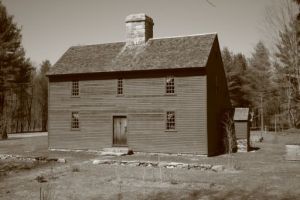
Deacon Peter Buell House

THE DEACON PETER BUELL HOUSE
This remarkable 1723 center-chimney, chestnut framed Georgian farmhouse was constructed by Captain/Deacon John Buell near a place commonly called “Watch Tower.” The dwelling was passed on to his son, Peter, in 1734, and a “lean-to” was added. The house was held by the Buell family until 1863, when it was sold, and then reclaimed again in 1923, and finally sold in 1958. In 1961, the house narrowly escaped demolition and was rescued and moved to Milton. Here, the home was restored to reflect domestic life as it existed during Peter and his heirs’ fifty-year tenure. Today, the Buell House stands as a document to 18th century rural family life in Litchfield. Highlights of the home include transverse summer beams, a pine sheathed ceiling, six-over-four sash above entry and wide board chestnut and pine flooring. Extensive renovations recently completed by the home’s current owner include a new rear addition with all the amenities and comforts of modern day living.

Dickinson Farm
Dickinson Farm

DICKINSON FARM
In 1726, Benjamin Boardman was granted the land on which this house stands to work as a farm. Today, the Dickinson Farm is one of the few remaining intact farms in Litchfield, dating back to the 18th century. The existing Colonial house was constructed circa 1760 and was designed as a five bay central chimney residence. During the 19th century, a two bay extension was added, and for a period of time, served as a cobbler’s shop. In 1849, Edwin P. Dickinson bought the house and surrounding farm land. This property remained in his family for the next 110 years. The current owner added on a great room in the back of the house for use as an art studio and to display family art. The fabulous wall mural in the dining room, illustrating Litchfield history, is a continuing work in progress.

Fox Ridge
Fox Ridge

FOX RIDGE COTTAGE
Built in 1996, this stunning Adirondack-style Cape home was sited on a granite ridge overlooking a small stream and fox den. The interior features include nine-foot ceilings, wide plank hardwood flooring, two fireplaces and a state-of-the-art kitchen. Attached to the back of the house is a screened three season porch, and an outdoor hot tub and shower, with undisturbed views of the woods. Towards the back of the home is a new outdoor retreat center. This enchanting section of the garden features unique stump seating around an open fire pit. The grounds on the south side of the home include a heart-shaped herb garden and a crescent moon-shaped perennial garden.
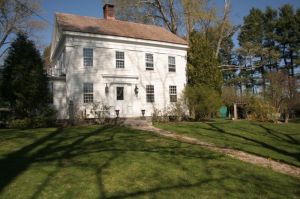
White Bridge Farm
White Bridge Farm

WHITE BRIDGE FARM
The oldest part of this home was built by Levi Coe, Sr., circa 1787, on twelve acres. In 1832, Levi Coe, Jr. inherited the home and enlarged the property to 300 acres, added the Greek Revival elements to the house and named it Cloverdale Farm. The notable Greek Revival details include recessed panels on the pilasters, double fascia board with stringcourse molding, and the trabeated (horizon beams or lintels), in the entry. The south parlor displays distinctive door surrounds with eared architraves (moldings surrounding doors), and splayed (oblique angled or beveled) frames. The newel post is original to the house. Also of historic significance are the maple trees lining the front of the house, which are said to have been planted by Civil War veterans. The glass greenhouse on the south elevation is a modern addition. An in-ground pool, bath house, tennis courts, livestock arena, two barns and a 1920’s office building are located on the property.
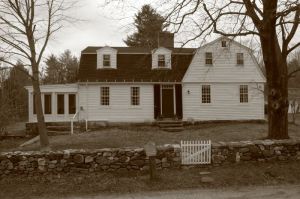
William Sprat(s) House

WILLIAM SPRAT(S) HOUSE
William Sprat(s), a British soldier of Scottish decent, came to Hartford and Litchfield as a paroled war prisoner following the defeat of General Burgoyne, prior to 1779. Sprat(s) bought five acres of land in Milton in 1786 and as a trained architect and builder, built his own small gambrel dwelling. The house, erected in 1787 with a chimney and front entry on the original North-end, was typically called a “half-house.” A shoemaker’s shop operated in the residence from 1814-1834. In the 20th century, the present north side and gambrel roof were joined to the original house. Dormers were added in the 1920’s. Highlights of the original house include the well in the kitchen, the raised panel doors throughout the house, Litchfield hardware on some doors and a five light transom above the door. Of interest outside are a vintage three seat outhouse and various sheds.

STARR AND ZIEHL GARDEN
At the end of this delightful formal garden, an Adirondack-style pergola overlooks a small brook with a large granite slab set in the earth to serve as a bridge. Gravel paths lead to an impressive sized millstone centered within the courtyard and an Adirondack-style bench sits on the opposite side of the pergola to take in a view of the entire garden. The north side of the garden includes shade perennials and decorative stone work. Ornamental pear and cherry trees in stone lined ovals, lead your eye to a stone bench, anchoring the South side of the garden. Other plants in the garden include hornbeams – a small hardwood tree, as well as boxwoods, blueberry bushes and honeysuckle growing on a trellis.

TICKETS
Tickets and information about the evening tour and cocktail reception may be obtained by calling the Connecticut Junior Republic (860) 567-9423, ext. 278. Advance tickets for the general tour on Saturday are $30.00 and may be ordered by contacting the Litchfield Aid of CJR, P.O. Box 214, Litchfield, Connecticut 06759. Please include a stamped, self-addressed envelope with your credit card information, or check or money order, made payable to: Litchfield Aid of CJR. Those using credit cards (American Express, MasterCard and Visa) for payment should provide account name, number, security code and expiration date. Discover Card is NOT accepted. Advance orders are non-refundable and must be received no later than Friday, June 28. Requests for tickets after this date will be held for pick-up on the day of the tour at the ticket tent on the Green. Special rates are available for tour groups that reserve a minimum of 20 tickets in advance.

Tickets for the Saturday Tour from 10: AM to 4:00 PM will be sold on the date of the event for $35.00 for adults and children on the Litchfield Green. (No charge for infants.) Further information about the House Tour and ticket sales may be accessed online: www.litchfieldhousetour.org.

The Litchfield History Museum and the Tapping Reeve House and Law School, recognized as the first law school in America, will be included in the admission price of the tour. The History Museum is currently featuring the exhibition, The Hour of Conflict. This exhibition examines the ways in which the American Civil War im¬pacted the residents of Litchfield, Con¬necticut in the 1860s, and will be on display for the House Tour.

LUNCHEON
Visitors may enjoy lunch at the Connecticut Junior Republic for $7.00 from 11:30 AM to 2:30 PM. A choice of a seafood salad or smoked turkey and Swiss cheese sandwich plate, including pasta salad, brownie, and iced tea, will be offered by CJR students. The luncheon may be viewed on the House Tour website: www.litchfieldhousetour.org.

AREA INFORMATION www.litchfieldhills.com

64th Annual House Tour To Feature Historic Litchfield Homes

The 64th Annual Open House Day Tour of Litchfield to benefit the Connecticut Junior Republic (CJR) will be held Saturday, July 9, 2011 from 10:00 AM to 5:00 PM, rain or shine. Conducted by the Litchfield Aid of CJR, an auxiliary, volunteer organization, the 2011 event features six well-appointed homes and historic buildings, many of which are within walking distance to the center of town and Litchfield’s famous historic district. Additional historic points of interest are also included in the Tour. The 2011 event celebrates the Centennial of the Litchfield Aid which was established in 1911,for the sole purpose of supporting the Connecticut Junior Republic.

One of the oldest events of its kind in the country, the self-guided, walking tour begins at the Information Booth on the Litchfield Green. Ticket sales, information and the “lost and found” will be located here.

A Preview Tour will be offered the evening of Friday, July 8, from 5:30 – 7:30 PM, followed by a cocktail reception from 7:00 – 9:30 PM in a magnificent private garden located in the heart of Litchfield’s historic district. This year’s party will be catered by the The Pantry of Washington Depot. Tickets are $90 per person and attendance is limited. Highlights of the 2011 tour are as follows:

The Farmer’s House

Built in 1840, this house was purchased by Joseph W. Goddard in 1883, when developing his estate. The house was used initially by the Goddards’ farmer, and as a caretaker’s cottage by subsequent owners of the estate. The house fell into a state of disrepair before it was rebuilt and renovated by subsequent owners. Set on 3.7 acres, this home features beautiful landscaping, a family room with radiant floor tiles and many other modern conveniences, while retaining the charm and traditional aesthetics of the 1800’s.

The Thompson – Di Giorgio House

Designed in 1935 by architect Albert Hopkins Pierce (1899-1974), this home was built for Walter C. Thompson, a former chief executive of the Torrington Company, and his wife, Margaret. The home is representative of the high-quality estates built in Litchfield during the first three decades of the Twentieth Century, and the structure ranks as one of the significant Colonial Revival residences on the south side of the Borough. Set on four acres, the home’s original features and lovely grounds have been painstakingly maintained and restored by the current owners. This gracious residence features five working fireplaces and epitomizes the elegance and superb detailing for which the academic Colonial Revival style is noted. Notable highlights include 83 original doors and windows and more than 1,600 triple-glazed window panes; a concealed rear elevator that runs from the basement to the second floor; mature landscaping that includes orchards, gardens, meadows and extensive stonework; and a spacious entry hall featuring a gracious turned staircase.

MacLaren Walcott House

Built in 1894 by William and Louisa MacLaren on land formerly owned by dairy farmer Ratchford Starr, this property features a carriage house that has been remodeled as a guest house. The original barn belonging to the property is now a residence on Meadow Street. The Wolcott Street residence transitions from Victorian to Colonial Revival and was a seasonal country house with many guest rooms for the MacLarens. The complex rooflines and the use of the clapboards on the first floor and shingles on the second floor are late Victorian, but the symmetry of the north façade and the Palladian window in the gable end typify Colonial Revival. Features include a pineapple doorknocker on the central entrance door, a symbol of hospitality; French doors from the living and dining room to the porch; and fireplaces in the living room, dining room and library.

The Peacocke House

Built in 1868 by John and Mary Peacocke, this gracious Victorian home remained in the Peacocke family until 1920. The current owners reconstructed the two-story front porch that was removed during the Colonial Revival period. Extensive renovations include the addition of a family room to the rear of the house, featuring a brick floor, fireplace, beamed ceilings, skylights and French doors to the bluestone patio. A side breakfast room was also added and the kitchen was completely renovated to include stainless steel appliances, glass-paned cabinetry, stone countertops and raised relief tiled backsplash. The original servants’ staircase remains. Highlights include the coffered ceiling, corner china cabinets, plate rail and leaded glass windows, which accentuate the elegance of the dining room.

The Joshua Mason House

Built in 1800 by Joshua Mason, this Colonial farmhouse is set on spacious grounds, simply and beautifully landscaped. The deed to the land dates to the “Reign of Our Sovereign Lord George the Second of Great Britain.” Said to have been a sheep farm, the original house became a summer cottage known as the Palmer House until 1960, when it became home to a young family. At some point in its history, small rooms were combined to create larger rooms but the fireplaces with new surrounds and some original floors remain.

The present owners made structural upgrades, expanded the kitchen, moved a garage building and opened the grounds to more expansive views of the gardens, apple trees and the new saltwater swimming pool. Highlights include the stunning, enlarged kitchen and the “birthing room” with unusually wide floor boards.

French doors lead to an old patio with a pergola facing the original perennial bed and to two new patios in the back with views of the pool. The old barn has been rehabilitated and contains a guest room/in-law apartment. A breezeway connects the newly located garage to the house in the manner of old farmhouses with attached “out buildings.”

Phineas Miner’s Law Office

Built in 1820 in the Greek Revival Style, this tidy building at 35 South Street was the law office of Attorney Phineas Minor. It is one of five such buildings in Litchfield intended for commercial use and was later occupied by Silas N. Bronson, who enlarged it for use as the Bronson Family Store. The sale of the property in 1905 resulted in its purchase by a civic-minded group that has owned and lovingly maintained it for more than a hundred years.

The façade owes its elegance and symmetry to the influence of the ancient Green temples and their imposing columned exteriors. Its fluted square posts, tall front door, and very large windows topped by an expressed frieze board, are all typical Greek Revival features. In the 1930’s, an exterior building was moved and attached to the house for use as a kitchen and a fireplace was added to the first floor. A 1930’s interior redecoration, which covered the original stained oak trim with harsh green paint, was modified in 2006 to create a softer, lighter appearance.

Preview Party – Oliver Wolcott, Sr. House

The Preview Party will be held in the beautiful gardens of the Oliver Wolcott, Sr. House, located in the heart of Litchfield’s Historic District. This classic post and beam, center chimney Colonial house was built in 1754, by Oliver Wolcott, Sr., on land bequeathed to him by his father, Roger, who was Colonial High Sheriff of Litchfield, a signer of the Declaration of Independence, and Governor of the state of Connecticut from 1796 until his death in 1797. The earliest extant Georgian house in the area, the home has many historic features as well as an orchard where the women and children of Litchfield gathered to melt down a statue of George III, to make bullets for use against the British in the Revolutionary War. Please note: The Oliver Wolcott, Sr. House property is the site of the Preview Party only and not part of the Saturday House Tour.

2011 marks the 100th anniversary of the Litchfield Aid of CJR, which was founded in 1911 by twelve Litchfield women for the sole purpose of supporting the Connecticut Junior Republic. In celebration of its 100th year, the Aid is featuring an exhibit of clothing from the early Twentieth Century at the Oliver Wolcott Library. The clothing exhibit will feature attire from the era of the Aid’s founding in 1911.

In addition to the clothing exhibit at the Oliver Wolcott Library, points of interest on the 2011 Tour include the churches of Litchfield and Lourdes of Litchfield, a shrine built in 1954 by the Montfort Missionaries as a replica of the famous Grotto of Our Lady of Lourdes in France. The Litchfield History Museum and the Tapping Reeve House and Law School, recognized as the first law school in America, will also be included in the admission price of the Tour. The History Museum will feature an exhibition, Goods for Sale! Cash, Credit and Trade in Litchfield 1790 – 1850, which will focus on Litchfield’s economic history during the first half of the nineteenth century.


General Information About The Litchfield House Tour

Advance tickets are non-refundable and may be obtained for $30.00 by contacting the Litchfield Aid of CJR, P.O. Box 214, Litchfield, Connecticut 06759. Please include a stamped, self-addressed envelope with your check or money order. All checks should be made payable to: Litchfield Aid of CJR. VISA and MasterCard (MC) are also accepted. Credit card orders should include type of card (VISA or MC), card number, expiration date, name on credit card, billing address and signature. Please note that debit cards are not accepted. Orders must be received no later than Friday, June 24. Requests for tickets after this date will be held for pick-up on the day of the Tour at the ticket booth on the Green. Advance tickets are also available at KitchenWorks, Murphy’s Pharmacy, and Talbots, all located in the center of Litchfield. Tickets for both the Saturday Tour and Preview Tour and Party may also be purchased on-line: http://www.litchfieldct.com/cjr/tour.html. Tickets will be sold on the Green on the day of the tour for $35.00 each for adults and children. (No charge for infants.) General information about the Open House Tour may be obtained by contacting the Connecticut Junior Republic at (860) 567-9423 between 9:00 AM and 4:30 PM. A special group rate of $25.00 per person is offered for tour groups that reserve a minimum of 20 tickets by Friday, June 24.

LUNCHEON

Visitors may enjoy lunch at the Connecticut Junior Republic for $7.00 from 11:30 AM to 2:30 PM. A choice of a seafood salad or smoked turkey and Swiss cheese sandwich plate, including pasta salad, brownie, and iced tea, will be offered. The luncheon may be viewed on the House Tour website: http://www.litchfieldct.com/cjr.tour.html. Students will provide tours of CJR’s beautiful rural campus and student crafts will be exhibited and sold.

The Litchfield Aid’s popular and unique cookbook will be sold at the luncheon ticket tent on the Litchfield Green for $19.00, including tax. Each copy of The Cook Book comes with its own handmade gift-wrapping and makes a wonderful “ready-to-give” present for family, friends and professional associates.

Founded in 1904, the Connecticut Junior Republic (CJR) provides care, treatment, education and family support for at-risk, special needs and troubled young people so they can become productive and fulfilled members of their homes, schools and communities.

The Junior Republic conducts a residential program for court-referred young men on its Litchfield campus. Special, vocational and alternative education programs are provided for boys from communities throughout Connecticut at CJR’s Cable Academic and Vocational Education Center, which is also located on its Litchfield campus. Transition and related services are also provided.

CJR provides a further dimension of residential care for boys at its group homes in East Hartford and Winchester, as well as short-term, residential crisis intervention for girls at its Center for Assessment, Respite and Enrichment (CARE) in Waterbury. A broad spectrum of prevention, early intervention, family support, and intensive home-based services, and aftercare, are provided for boys and girls through CJR’s offices in Danbury, Meriden, New Britain, Torrington and Waterbury (two sites).

A private charitable organization, the Connecticut Junior Republic is accredited by the Council on Accreditation (COA) and the New England Association of Schools and Colleges (NEASC). CJR is supported by gifts from individuals, businesses and organizations, and through service contracts funded by the Court Support Services Division (CSSD) of the Connecticut Judicial Branch, the Connecticut Department of Children and Families (DCF), the Connecticut Department of Social Services (DSS), and by Connecticut’s public schools.

For further information, or to obtain photos of the 2011 Tour Houses, please contact Hedy Barton, Director of Development and Public Relations (860) 567-9423, extension 252; or by email: hbarton@cjryouth.org.