BraeVal and Rob Roy!

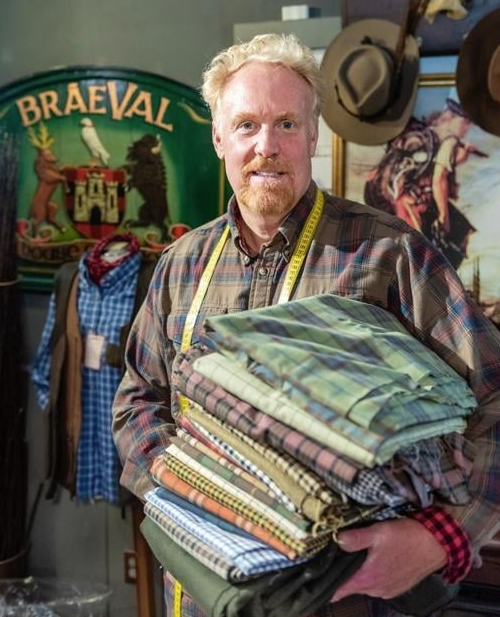
One of the leading men’s outdoor apparel companies, BraeVal, headquartered in Litchfield is well known for its field duty collection of shirts and jackets perfect for outdoor adventure. The foundation of this brand is on form and function in the field, at the office, or on a night in the town. One of the founder’s uncles brought the Rob Roy MacGregor tartan, known today as Buffalo Plaid to America in the 1800s. Today, the neckline and cuffs of every shirt and jacket hand-crafted by BraeVal are lined with Buffalo plaid.

Hero or villain, Rob Roy made an indelible impact on Scottish history for his dastardly deeds of cattle raiding and robbing from the rich and giving to the poor. The legend of Rob Roy is known throughout the world. It has been made popular by books, poems, and movies. There is even a drink created in his honor that dates back to 18th-century New York City.

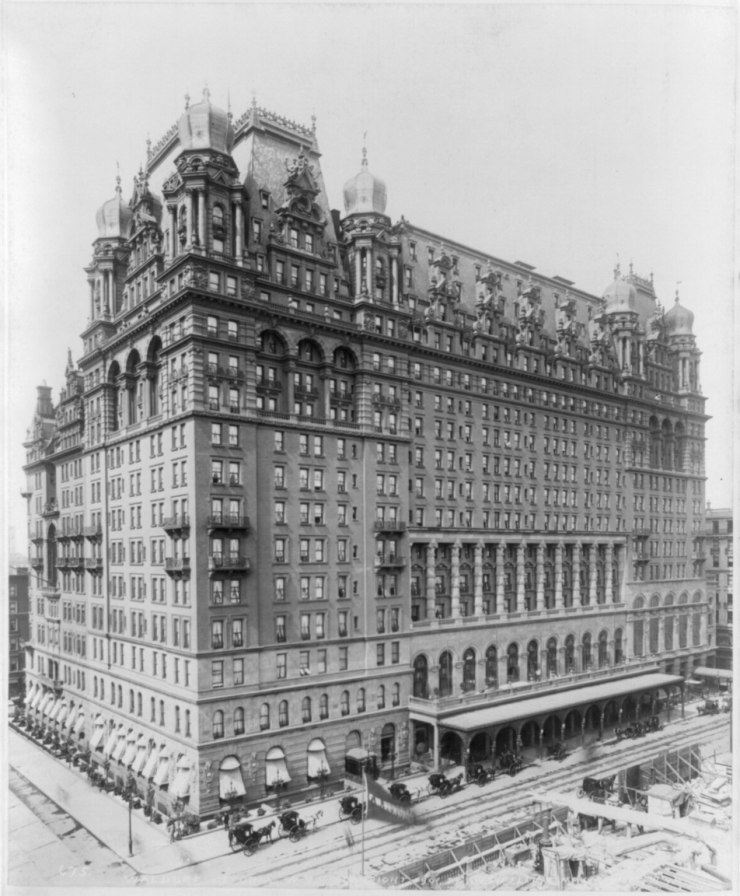
One of the ways to stay ahead of the pack as a hotelier and restaurateur in NYC in the 1890s was to create a new cocktail sensation and name it after a popular production to draw clients in the door. That said, most folks believe that the birthplace of the Rob Roy cocktail was at New York City’s infamous Waldorf Astoria in 1894. At that time, the Waldorf was located where the Empire State Building now stands. Just down the block from the Waldorf, The Herald Square Theater, was producing Reginald De Koven’s operetta called “Rob Roy,” based on the life of the Scottish folk hero. The bartender at the Waldorf decided to create a new drink, the Rob Roy, to promote the hotel and the opening of this performance. Similar to a Manhattan, the bartender prepared his new Rob Roy creation with scotch instead of rye whiskey. It was a sensation and became popular across the country.

Historian David Wondrich’s recent research led him to conclude that the Rob Roy cocktail was a creation borrowed from Duke’s House in Hoboken, New Jersey. The story goes that a salesman for Usher’s Scotch was invited to join a table of men drinking Manhattan’s at Duke’s and he said he would only join them if a round of drinks were made using his company’s scotch. The bartender, Henry A. Orphal, created the Rob Roy using Usher’s Scotch and it was a hit. Another historian claims that the birthplace of the Rob Roy was the swank Fifth Avenue Hotel, just up the street from the Waldorf.

Regardless of who created this cocktail, it is still popular today. Essentially a Rob Roy is a Manhattan created for a scotch lover. It is less sweet than a Manhattan because the scotch adds a touch of smoke to vermouth’s sweetness, giving this drink balance. It is made by combining scotch with sweet vermouth and a dash of bitters and served either with a Maraschino cherry or a twist of lemon… be decadent, have it with both!

Tap into a Native American Tradition @ Maple Sugar Festival @ Institute for American Indian Studies March 2

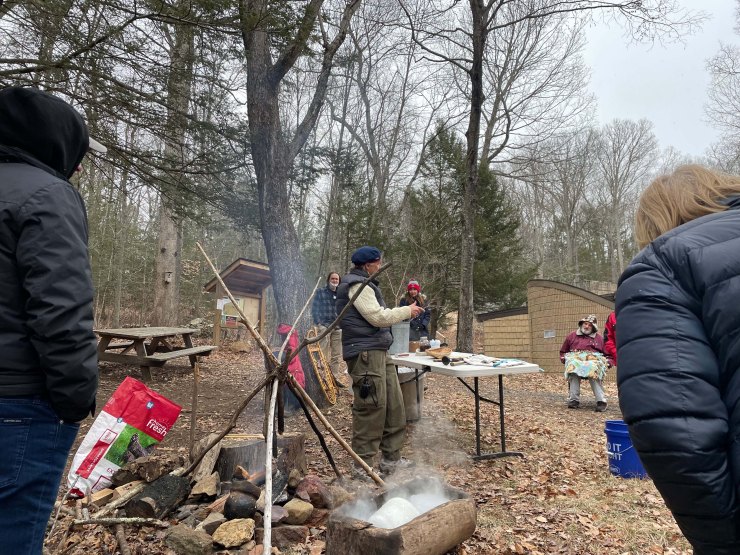
Maple syrup has long enjoyed pride of place on many breakfast tables. The origin of this sweet spring elixir isn’t part of a trendy branding campaign; it is the widely unknown discovery of Native Americans, who have tapped trees for maple syrup since time immemorial. On March 2, the Institute for American Indian Studies in Washington, Connecticut is hosting its annual Maple Sugar Festival, from 11 a.m. to 4 p.m. to celebrate the original legacy of maple syrup.

Indigenous communities in the Northeast and Canada harvested sap from maple trees, boiling down sap and turning it into sugar water and maple syrup long before European contact. Special sugar camps were set up in groves of sugar maple trees and much like this festival, sugaring became a social event. “At the Institute’s Maple Sugar Festival, families will see firsthand how Native Americans harvested this sugary delight, a process that has been passed on through stories and demonstrations from generation to generation,” said Chris Combs, Executive Director of the Institute. “Most importantly, they’ll learn why this process is such an important part of Native American culture,” Combs added.

At this event, IAIS Educator and Ecologist, Susan Scherf will demonstrate various traditional Native American techniques of collecting sap and boiling it down into syrup and sugar. Visitors will learn the importance of maple sugar to the diet of Native Americans as well as its usefulness as an item of trade, and even as medicine.

In keeping with the fun-filled traditions surrounding Native American sugar camps, children are invited to listen to Native American stories and play traditional family-friendly games that will take place throughout the day, adding to this culturally enriching experience. To satiate your taste buds, maple syrup, samples from the Passamaquoddy Tribe of Maine are being offered. And, if you want to bring some of this delicious amber nectar home, head to the Institute’s gift shop which is stocked up with maple syrup made by the Passamaquoddy Tribe.

The cost of participation is $15 for adults, $10 for children, and $5 for members of the Institute. To pre-register head to The Institute for American Indian Studies Museum & Research Center, email events@iaismuseum.org, or call (860) 868-0518.

About The Institute for American Indian Studies
Located on 15 acres of woodland acres the Institute For American Indian Studies preserves and educates through archeology, research, exhibitions, and programs. They have a 16th c. Algonquian Village, Award-Winning Wigwam Escape, and a museum with temporary and permanent displays of authentic artifacts from prehistory to the present allows visitors to foster a new understanding of the world and the history and culture of Native Americans. The Institute for American Indian Studies is located at 38 Curtis Road, in Washington, Connecticut.

The Magic of Courting Flutes @ Institute for American Indian Studies Feb. 17

The Institute of American Indian Studies at 38 Curtis Road in Washington has a wonderful way to end Valentine’s Day week. On Saturday, February 17, beginning at 1 p.m., Ojibway artist, and musician Allan Madahbee will explain the cultural significance and demonstrate the hauntingly beautiful sound of the Native American courting flute. A highlight for participants is to learn why the courting flute is deeply rooted in the traditions of many Native American Cultures.

Today, makers of Native American Flutes like Ojibway artist and musician Allan Madahbee craft their style and sound into their creations. Madahbee began to research the Chippewa flute culture and was influenced and mentored by Joseph Firecrow of the Cheyenne Nation. “We became friends and he provided guidance and feedback and explained some of his methods of flute making. With his passing, we have all lost a great Native American flute maker and musician. I am proud to continue our flute-making traditions.” The sound of the courting flute, which is usually made of cedar, has an uncommon scale for Western music and is entrancing.

Participants will listen to this haunting music performed by Madahbee, hear the legend of the courting flute, and examine the unique construction of a collection of flutes on display. There will also be a limited number of original, one-of-a-kind handmade courting flutes for purchase. Space is limited and pre-registration is requested. To reserve a spot head to http://www.iaismuseum.org, email events@iaismuseum.org, or call (860) 868-0518. The price of participation is $5 for IAIS Members and $15 for Non-Members.

About Allan Madhbee
Born on Manitoulin Island, the Home of the Great Spirit, Allan Madahbee is a member of the Ojibway (Chippewa) Nation who has pursued the traditional arts and crafts of his ancestors. He has been making Native American flutes for about ten years. “I had always thought they were a product of the Southwest Indian tribes, but a book that I found that was written during the 1800s about Chippewa culture, had a passage about the Chippewa flutes, along with pictures. This made me realize that they were indeed a part of my Chippewa culture. Knowing that my ancestors constructed these flutes for hundreds of years has inspired me to continue this tradition. Also, the haunting sound from these mystical instruments is a large part of my inspiration.”

About the Institute for American Indian Studies
Located on 15 acres of woodland acres the Institute For American Indian Studies preserves and educates through archeology, research, exhibitions, and programs. They have the 16th c. Algonquian Village, Award-Winning Wigwam Escape, and a museum with temporary and permanent displays of authentic artifacts from prehistory to the present allows visitors to foster a new understanding of the world and the history and culture of Native Americans. The Institute for American Indian Studies is located at 38 Curtis Road, Washington, CT.

Valentine’s Day Gifts They’ll Fall in Love With @ Tina’s Baskets & Woven Art & Shop and Sip Event

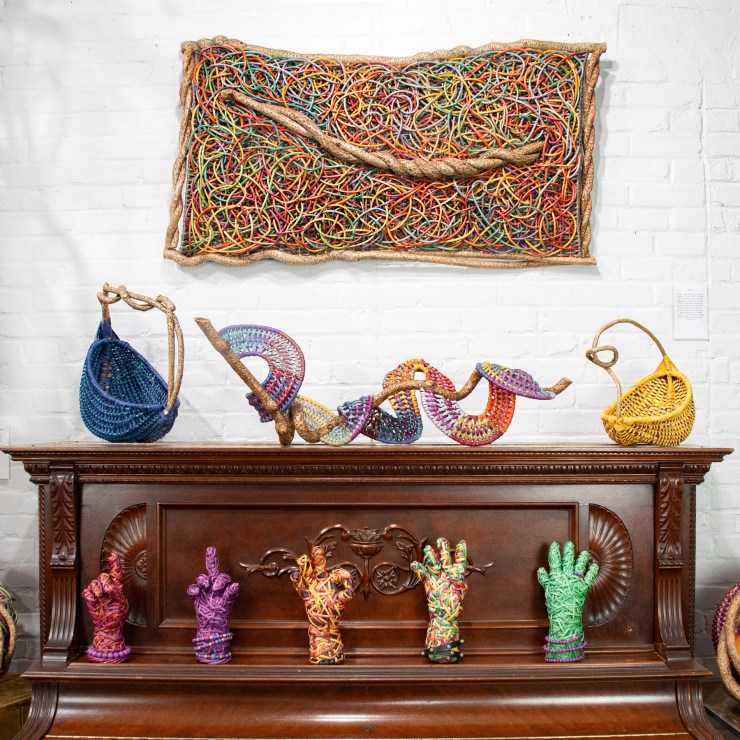
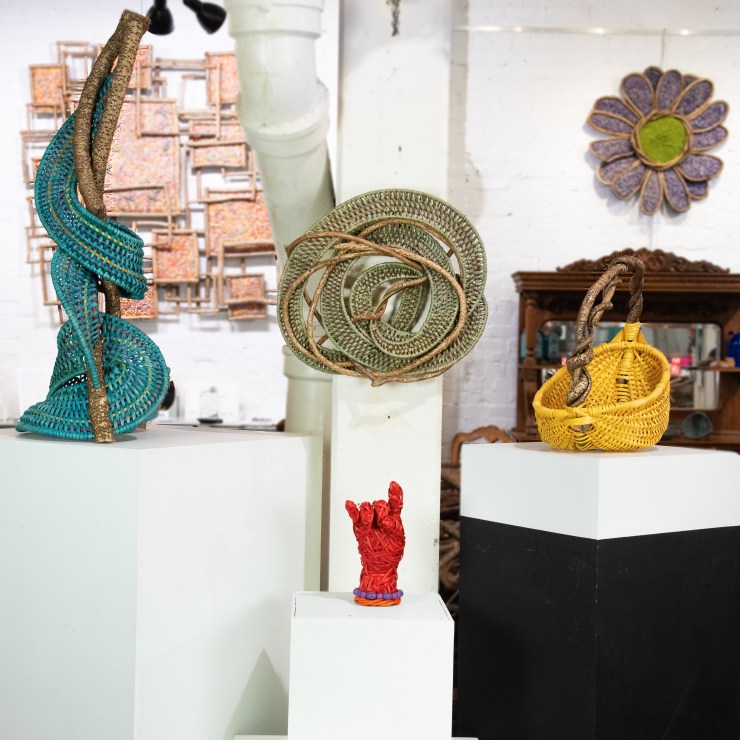
This February Tina’s Baskets and Woven Art at Whiting Mills in Winsted is celebrating love in all its forms with a wonderful array of handmade baskets, bowls, woven wall hangings, and sculptures. These meticulously beautiful pieces of art are perfect to celebrate Valentine’s Day and the enduring bonds between close friends, family, and seldom-seen pals.

This amazing studio is filled to the brim with swoon-worthy art created by Tina Puckett, a national and international award-winning artist, known for her woven art and dimensional weaving. It is fun to visit a working art studio to explore this exquisite selection of thoughtful gifts that you’re nearest and dearest will be smitten with!

Not to be missed is the Second Annual Valentine’s Day “Shop and Sip” event at Whiting Mills on Sunday, February 11th from 11 a.m. to 4 p.m. Whiting Mills will be buzzing with activity with more than 20 art studios and artisan shops open and offering complimentary refreshments and treats, along with one of a kind gift items perfect for Valentine’s Day. To add to the fun, there will be live acoustic music throughout the day in this festively decorated historic mill building that is Instagramable.

While browsing in Puckett’s studio, and chatting with Tina as she weaves her magic, enjoy chocolates and champagne. If you are on the hunt for an unforgettable Valentine’s Day gift basket to fill with goodies, this is the place, a real artist’s studio in fact, to check out! Tina’s Studio is open every weekend in February from 11 a.m. – 4 p.m. or by appointment, Shopping for your Valentine has just become easy because a gift from Tina’s Baskets and Woven Art shows your special someone that you truly care.

About Tina’s Baskets
Tina Puckett is a nationally awarded weaver of baskets and woven art who is the owner of Tina’s Baskets which is located at Whiting Mills in Winsted, Connecticut. Tina has been weaving since 1981 using hand-dyed reeds, bittersweet, and a variety of objects like beads or seagrass. Her work is showcased at a variety of galleries across the United States as well as at her gallery/studio where you will often find her weaving on weekends from 11 a.m. to 4 p.m. Custom orders are accepted and appointments can be arranged by texting 860-309-6934.

Hot Chocolate Festival @ White Silo Farm

There is no better way to warm up to winter than sipping on Hot Chocolate at White Silo Farm in Sherman. On Saturday, February 3, and Sunday, February 4 from 12 noon to 4 p.m. White Silo Farm is celebrating its third hot chocolate and s’mores festival!

Guests will have the chance to taste four types of hot chocolate – white, milk, dark, and Mexican. It is fun to top off your cups with homemade marshmallows, whipped cream, chocolate sprinkles, and other fixings. They have also added homemade S’mores to eat with your hot chocolate(s). Bring your friends and enjoy a WARM afternoon in their winery, it is an ideal way to spend a cold winter day. Special food items to pair with your hot chocolate will be available to purchase To add to the fun, there will be live music on both days from 1 p.m. to 4 p.m. On Saturday Al Rivoli will perform and on Sunday Don Lowe will be at the farm to entertain guests.

The price is $25 per person. It includes one glass of wine or nonalcoholic beverage to sip with your hot chocolate(s). They have scheduled two sessions each day, the first from 12 noon – 2 p.m. and the second from 2 p.m. – 4 p.m. Advance tickets are required and limited. We hope that you can join us. For tickets click here.

Skiers Soar Through the Air Feb. 2-4 @ Salisbury’s Jumpfest

This year if you are looking for a new winter sport to fall in love with ski jumping may be the exact option for you! One of the best places to see this highly respected sport on the East Coast is at Salisbury’s Jumpfest on Friday, February 2nd Saturday, February 3rd, and Sunday, February 4th. The thrill of this event is that there are often Olympic hopefuls competing. And, even if there is no snow where you live, Satre Hill is always glistening in all its Alpine beauty, with white powdery snow thanks to the Salisbury Winter Sports Association’s (SWSA) state-of-the-art snow guns.

Let’s face it, some of us can’t ski, let alone fly through the sky with the hope of landing with elegance. Watching ski jumpers, many of whom just might be future Olympians is an unforgettably thrilling experience. One thing that keeps this sport exciting is that the margins are so fine and unpredictable that there is always a wide variety of winners and performances. Once you realize how difficult and technical this sport is it becomes even more interesting and inspiring to watch, live. “Salisbury’s Jumpfest is going to be bigger and better than ever,” said Willie Hallihan, SWSA Director. “It’s a winter event that you won’t want to miss. The hint of frost in the air, the sound of ringing cowbells, and the crowds cheering on their favorite as the skis slap the landing hill make this event one of a kind.”

Jumpfest offers three days of heart-pounding excitement and competitions to watch. The tower stands 70 feet atop Satre Hill and jumpers perch on their bar 350 feet above the ground. As the go flag is dropped they speed their way down the 300-foot run, picking up speed along the way. Imagine watching as jumpers soar up to 200 feet through the air at speeds of 50 miles an hour! There are only six ski jumping venues on the East Coast and Salisbury is one of the oldest and most respected because of past hopefuls that competed in the Olympics.

Friday’s events kick off when the gate opens at 6 p.m. The highlights of the night begin with Target Jumping at 7 p.m. The popular Human Dog Sled Race follows the Target Jumps where teams of six compete in this madcap event for a variety of prizes. There are only half a dozen places or so in the country that host this type of event and most of them are pretty far from Connecticut making this a spectacle of fun something not to be missed! To enter, email info@jumpfest, attention Brian. The fee to enter is a modest $25 per team that includes free entrance to Jumpfest! Proceeds benefit SWSA’s Junior Ski Programs.

On Saturday, February 3, the small hill opens at 8 a.m. for practice jumps. The Junior Competition on the 20-meter and 30-meter hills starts at 9:30 a.m. and is followed by the Salisbury Invitational Ski Jump on the 65-meter hill at 1 p.m. The day ends with the Snowball Fundraiser at the Lakeville Town Grove with music by the Steve Dunn Band.

On Sunday, February 4 the 65 meter hill opens at 11 a.m. The Eastern U.S. Ski Jumping Championships, the big event of the weekend begins at 1 p.m. The crowd murmurs as they watch these expert athletes sit on a bar at the top of the hill waiting for the signal to go. You can almost feel the focus. Jumpers lead with their helmet; throw their hands back, and crouch low into a tuck with a flat back for aerodynamics. Balance and flexibility are the order of the day. The most critical part of the jump is the take-off which lifts the jumper’s body for flight. Most folks can’t believe how quickly time flies when watching this sport, a mere 20 seconds or so from the top of the hills to the bottom! The winners of the Eastern U.S. Ski Jumping Championships will make up the Eastern Division of the Junior National Team and will be named after this competition awards ceremony concludes.

To add to the festivities there are food trucks, craft beer, hot toddies, and bonfires to enjoy against the backdrop of skiers flying through the air! And, if you work up an appetite, no worries, the Cook Shack offers a range of burgers, dogs, hot chocolate, and more, and the Low N Slow Food Truck serves BBQ, authentic poutine, mac n’ cheese, and many other selections on three days. There will also be a wine tent, a hot toddy tent, and the Great Falls Brewing Company’s beer tent.

Tickets will be available at the gate and are $15 for adults on Friday, Saturday, and Sunday. Kids 12 and under are free all three days. The cost of the Snowball is $20 and includes a cash bar, music, raffles, and pizza at 10 p.m. The ski jump complex is located at Satre Hill on Indian Cave Road in Salisbury. Before setting out check www.jumpfest.org for updates, scheduled changes, or more information or email the Association at info@jumpfest.org.

ABOUT SALISBURY WINTER SPORTS ASSOCIATION
The mission of the Salisbury Winter Sports Association is to acquaint the public with Nordic ski-jumping, cross –country and Alpine skiing, and to teach the skills necessary for their enjoyment. One way of fulfilling this mission is to host the annual Jumpfest Competition on Satre Hill to sustain and ski jumping in Salisbury, Connecticut, and the Eastern United States.