Inside the Artists’ Studios: Small-Scale Views at the Bruce Museum in Greenwich CT

If you have ever wished you could observe artists engaged in the process of creation, Inside the Artists’ Studios presented by the Bruce Museum on One Museum Drive in Greenwich allows you to explore the individual investigations and analyses of four artists through their paintings, prints, photographs and three-dimensional miniature constructions. This exhibit runs through March 9 and features a Guide-by-Cell Audio Tour that is free of charge and may be accessed simply by using your cell phone.

The artists participating are well known and bring special skills to this exhibit.
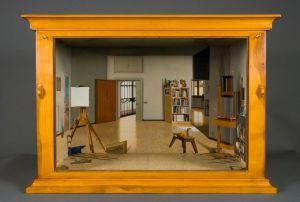
Perspective Box Jimmy Sanders (American, b. 1963) Perspective Box, 2007 Wood, oil paint, 28 x 36 x 28 in. New Britain Museum of American Art, New Britain, CT Photo courtesy of Hirschl & Adler Modern, New York
Perspective Box
Jimmy Sanders (American, b. 1963) Perspective Box, 2007
Wood, oil paint, 28 x 36 x 28 in.
New Britain Museum of American Art, New Britain, CT Photo courtesy of Hirschl & Adler Modern, New York

Jimmy Sanders, for example has been influenced by the work of 17th-century Dutch painters, most notably in his Perspective Box, Studio in Florence, which he modeled after his own Florentine studio. Sanders traveled in Europe in the late ‘90s and, after seeing Hoogstraten’s A Peepshow with Views of the Interior of a Dutch House (c. 1655-60; The National Gallery, London), was inspired to create a contemporary version of this Old Master creation.

Lori Nix Studio Lori Nix (American, b. 1969) Lori Nix Studio, 2013 Chromogenic print, 42 x 69 in. Courtesy of the Artist © Lori Nix
Lori Nix Studio
Lori Nix (American, b. 1969) Lori Nix Studio, 2013 Chromogenic print, 42 x 69 in. Courtesy of the Artist
© Lori Nix

Describing herself as a “non-traditional photographer,” Lori Nix constructs her sets and then photographs them. After photographing the “scene” she has laboriously
constructed, Nix dismantles the diorama, leaving the photograph as the ultimate creative object. Her latest project is a self-reflective examination of her own crowded living/work space.

The Art of Painting Richard Haas (American, b. 1936) The Art of Painting a.k.a.The Allegory of Painting, 1968-69 Wood, cardboard, cloth, paper, acrylic, pencil, masonite, lights, 221/2 x221/2x221/2in. Courtesy of the Artist Art © Richard Haas/Licensed by VAGA, New York, NY
The Art of Painting
Richard Haas (American, b. 1936)
The Art of Painting a.k.a.The Allegory of Painting, 1968-69 Wood, cardboard, cloth, paper, acrylic, pencil, masonite, lights, 221/2 x221/2×221/2in.
Courtesy of the Artist
Art © Richard Haas/Licensed by VAGA, New York, NY

Richard Haas began exploring the artist’s studio environment in the 1960s. He started with iconic masters, then moved into creating dioramic boxes of his contemporaries’ studios – including Jackson Pollock and Franz Kline – as well as views from his own 12-foot studio windows in New York’s then-gritty and industrial SoHo.

ack the Dripper Joe Fig (American, b. 1968) Jack the Dripper, 2006 Cibachrome print, Ed. of 10, 16 x 20 in. Courtesy of the Artist and the Tierney Gardarin Gallery, New York
ack the Dripper
Joe Fig (American, b. 1968)
Jack the Dripper, 2006
Cibachrome print, Ed. of 10, 16 x 20 in.
Courtesy of the Artist and the Tierney Gardarin Gallery, New York

Examinations of artists’ working lives also inform the pieces created by Joe Fig. Like Haas, Fig moved to the representation of contemporary artists’ spaces, interviewing artists before recreating their studios in miniature. Fig’s intimate views clearly appeal to the viewer’s desire to sneak a peek into the artistic process of artists such as Chuck Close, Ross Bleckner, Eric Fischl, April Gornik, Bill Jensen, Ryan McGinness, Philip Pearlstein, James Siena and Joan Snyder.

About the Bruce Museum: Explore Art and Science at the Bruce Museum, located at One Museum Drive in Greenwich, Connecticut. The Museum is open Tuesday through Saturday from 10 am to 5 pm and Sunday from 1 pm to 5 pm; closed Mondays and major holidays. Admission is $7 for adults, $6 for students up to 22 years, $6 for seniors and free for members and children under 5 years. Individual admission is free on Tuesday. Free on-site parking is available and the Museum is accessible to individuals with disabilities. For additional information, call the Bruce Museum at (203) 869-0376 or visit the website at www.brucemuseum.org. For area information www.visitfairfieldcountyct.com

Two New Exhibits at Five Points Gallery, Torrington

Five Points Gallery, a Downtown Torrington gallery, located on 33 Main Street is featuring contemporary work by professional artists, is presenting two new exhibitions that will run through February 2nd.

Shortell_Birds_of_a_Feather

In the West and North Galleries, the show, curated by Michael Shortell is “Cut and Paste: The Art of 21st Century Collage and Assemblage”. Featured artists include: Caryn Azoff, Nancy Doherty, Jon Eastman, Anne Gilman, Jane R. Lubin, M.D., Jane Rainwater, Rashmi Talpade, Paul Theriault and Deborah Wadswort. The art of collage has become more sophisticated since the early 20th century when artists like Braque and Picasso first used scraps of newspaper in their drawings. For this show, Michael Shortell has chosen a variety of works to illustrate the field of contemporary collage and assemblage and its evolution since the early 20th century. This exhibit shows how far contemporary artists have come in technique and content from the simple newspaper cutouts of early Cubism.

Danielle Mailer is the featured artist in the East Gallery with her show called Body Language 2013.. With influences ranging from Matisse to Klimt, to Miriam Shapiro, to Niki De Saint Phalle, Mailer creates dynamic works that offer her interpretation of the patterned silhouette. This installation features numerous 11-foot figures in acrylic paint on aluminum. An artist talk will take place at the Gallery on Friday, January 24th at 6 p.m.

Five Points Gallery is open Thursday, Friday and Saturday 1-5 and Sunday 1-3 and by appointment.

On February 1 at 2 p.m., three of the artists – Rashmi Talpade, Deborah Wadswort and Jane R. Lubin, M.D. will be at Five Points Gallery for a collage workshop. The workshop is free and open to the public. Space is limited and available on a first come, first served basis. To register www.fivepointsgallery.org.

For information on Litchifeld Hills where to stay, shop and dine visit www.litchifeldhills.com

Franklin Street Works Art Show is Amazing in Complexity

HISTORY-300x200

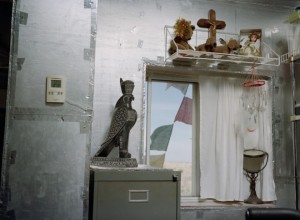
Franklin Street Works, www.franklinstreetworks.org presents Neuromast: Certain Uncertainty and Contemporary Art. The group exhibition explores “emergence,” the theory that says unforeseeable results happen when a system reaches a certain level of complexity. The show’s title is inspired by a very specific emergent phenomenon, “neuromast,” which is the sensory organ that allows fish to effectively behave in unison against the threat of predators. Neuromast features sculpture, videos, text-based works, photographs and more by contemporary artists, writers and theorists interested in theories of emergence.

Exhibiting artists are: Kari Altmann, Christian Bök and Micah Lexier, Ingrid Burrington, Kaye Cain-Nielsen, Mircea Cantor, David Horvitz, Brian House and Jason Rabie, Juliana Huxtable, Thilde Jensen, Carolyn Lazard, M. M. Mantua, Preemptive Media, Robert Spahr, Elizabeth Stephens and Annie Sprinkle’s Sexecology collaboration, and The Waterwhisper Ilse.

The exhibition is curated by Taliesin Gilkes-Bower and Terri C Smith and is on view from December 12, 2013 through February 23, 2014. It will open with a free, public reception on Thursday December 12 from 5:00 – 8:00 pm.

With Neuromast: Certain Uncertainty and Contemporary Art, several shared themes arose among the thirty-one works, including: how culture and gender contribute to constructing identity; the dynamic between an individual’s health and the medical industry, commerce, or the natural environment; and the collection and distribution of digital information as it relates to business, personal security, and persona.

13070711391-195x300

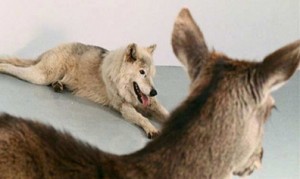
A primary inspiration of the show was a series of photographs by Thilde Jensen called The Canaries, which served as an inspiration for the exhibition. Her photographs document the lives of individuals living with heightened levels of sensitivity to the toxic chemicals and powerful electromagnetic radiation found in modern, built environments. Preemptive Media’s Air project also explores emergence and the environment. Their portable air quality measurement kits demand reflection on the proliferation of smart phones and pocket computers that do little beyond promise increased entertainment and productivity. Mircea Cantor’s video installation Deeparture juxtaposes predator and prey by placing a wolf and a deer in a typical white cube gallery space. The artist calls into question traditional narratives of danger and the inevitability of death while he simultaneously hijacks the gallery by excluding art objects and audience. With Elizabeth Stephens and Annie Sprinkle’s Sexecology project, the artists approach nature very differently, creating performative weddings that link the concept of a couple’s love to our love of the planet via inclusive, largely unscripted community events.

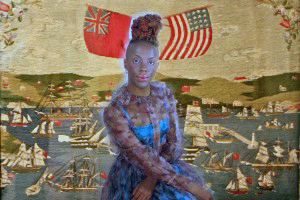
Neuromast also approaches personal identity as a microcosm of larger complex systems. Juliana Huxtable’s portrait series Seven Archetypes explores her process of gender transitioning through cultural expectations of performance. M. M. Mantua’s sculptures ask viewers direct questions that hint at the unequal distribution of privacy between viewer and artist while creating cognitive engagement through language. Brain House and Jason Rabie’s Facebook Portraits present identity through algorithm and data, attempting to humanize the ways in which social networks identify and classify their users. Kari Altman’s site- specific iteration of her Smart Mobility/Invisible Protection series calls into question abstract ideals of security as they relate to identity in finance and branding.

MirceaCantor-Deeparture-300x179

Moving out in scale to broader social phenomena, lngrid Burrington’s Center for Missed Connections identifies configurations of socially and sexually disconnected people in New York City through the missed connections section of Craigslist. David Horvitz also tried to change collectively authored online information through his zine documenting the artist’s attempted removal of himself from the group-edited encyclopedia site Wikipedia. Another text-based work that involves collaboration and an unpredictable outcome is Two Equal Texts by Christian Bök and Micah Lexier. The large vinyl wall work is an elaborate anagram that consists of two texts placed on either side of a freestanding wall. One side features Lexier’s descriptive text, which outlines the terms of the collaboration; the other side hosts Christian Bök’s elegantly resolved anagram of Lexier’s original text. Kaye Cain-Nielsen’s installation Miranda further explores the social consequences of shared responsibility in relationship to her own experience as a potential paid egg donor to an infertile couple.

Using contemporary art as its starting point, the artists in Neuromast investigate complex systems within social, environmental, and personal fields. The exhibition shows ways in which collective small-scale actions can prevail against seemingly insurmountable odds. Writer and activist Adrienne Marie Brown adds, “Rather than laying out big strategic plans for our work, many of us have been coming together in community, in authentic relationships, and seeing what emerges from our conversations, visions and needs. …We can define emergent strategy as intentional, strong because it is decentralized, adaptive, interdependent, and creating more possibilities.” The artists in Neuromast: Certain Uncertainty and Contemporary Art join in an interdisciplinary conversation on emergence via the adaptive and generate approach Brown sites, giving us insights into the often invisible, yet shared, complex systems that pervade our everyday lives.

Bird-Statue-copy-660x485-300x220

Franklin Street Works is located at 41 Franklin Street in downtown Stamford, Connecticut, near the UCONN campus and less than one hour from New York City via Metro North. Franklin Street Works is approximately one mile (a 15 minute walk) from the Stamford train station. On street parking is available on Franklin Street (metered until 6 pm except on Sunday), and paid parking is available nearby in a lot on Franklin Street and in the Summer Street Garage (100 Summer Street), behind Target. The art space and café are open to the public on Wednesday, Friday, Saturday, and Sunday: 12:00 p.m. – 5:00 p.m. with extended hours on Thursdays, 12:00 p.m. – 7:00 p.m. Franklin Street Works does not charge for admission during regular gallery hours.

Franklin Street Works is a not-for-profit contemporary art space, café, and social gathering place in Stamford, Connecticut. It produces original on-site and off-site exhibitions, artist projects, and related programming. Located in renovated row houses on Franklin Street, the two-story space includes three galleries and a café. Franklin Street Works embraces innovative art and exhibition practices, a DIY attitude, and a workshop approach to its programming, audiences, and organizational structure. The activities and attitudes of the café reflect and expand on the organization’s mission as a contemporary art venue.

For area information www.visitfairfieldcountyct.com
Closer: The Graphic Art of Chuck Close at The Bruce Museum

The Bruce Museum in Greenwich is presenting Closer: The Graphic Art of Chuck Close in the main Love, Newman Wild Galleries through January 5, 2013 with a portion on view in the Lecture Gallery through January 26.

With a body of work composed almost entirely of portraits, the American artist Chuck Close has been astounding us with his artistic verisimilitude for more than four decades. His prints, especially, are adventures in problem solving: working from the particularities of each print medium – woodcut, etching, silkscreen, linocut, aquatint, pulp-paper multiple – he gives his imagination free rein to reconceive their aesthetic possibilities. Although a spirit of experimentation characterizes Close’s work across all media, it is particularly evident in the wide-ranging scope of his printed production.

Chuck Close announced his arrival on the contemporary art scene with his large-scale, black-and-white airbrushed heads, paintings based on photographs he had transferred to canvas by means of a grid. Recognition came quickly: his work was shown at the Whitney Museum of American Art, New York, in 1969, followed by a solo exhibition at New York’s Bykert Gallery in 1970 and a one-man show at the Los Angeles County Museum of Art in 1971. In 1972 he created the first print of his professional career, a mezzotint, which began a life-long engagement with the aesthetics and technology of printmaking. The collaborative nature of this work has been vital to the artist’s creative process: working with master printers, Close alters one or several variables to create endless permutations in a wide variety of print techniques, usually recycling past portraits of himself, his family, and his friends.

The Bruce Museum is also sponsoring a lecture on Dec. 12 beginning at 7:30 p.m. It is titled Closer: The Art of Chuck Close in the Context of the 1970s that is being led by Kenneth Silver, PHD, Professor of Art History, New York University, Adjunct Curator of Art, Bruce Museum. There will be a dessert reception for both lectures from 6:30 p.m. – 7:30 p.m. and reservations are required. Visit www.brucemuseum.org to make reservations.

Closer: The Graphic Art of Chuck Close is accompanied by a generously illustrated catalogue by the same title. A lecture series and film series will also complement the exhibition.

About the Bruce Museum
Explore Art and Science at the Bruce Museum, located at One Museum Drive in Greenwich, Connecticut. The Museum is open Tuesday through Saturday from 10 am to 5 pm and Sunday from 1 pm to 5 pm; closed Mondays and major holidays. Admission is $7 for adults, $6 for students up to 22 years, $6 for seniors and free for members and children under 5 years. Individual admission is free on Tuesday. Free on-site parking is available and the Museum is accessible to individuals with disabilities. For additional information, call the Bruce Museum at 203 869-0376 or visit the website at www.brucemuseum.org.

Gregory James – Holiday Show

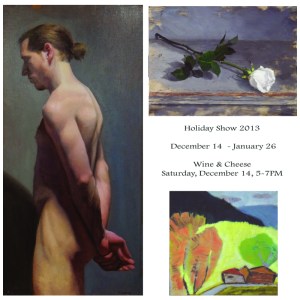
Gregory James Gallery – Fine Art & the Art of Framing located at 93 Park Lane road (route 202), New Milford, Connecticut, is pleased to announce its annual Holiday Art Show. The exhibit opens Saturday, December 14, and runs through Saturday, January 26, 2013.

Giarrano_White_Rose_on_Chest_11x14

The holiday show will feature Southbury, CT painter Thomas Adkins. Adkins recently painted a series of Lake Waramaug scenes. The gallery is also pleased to exhibit several of Washington, CT artist Vincent Giarrano’s genre paintings of contemporary life. Other gallery artists will included Scott Zuckerman of West Cornwall, CT, Christopher Magadini of Croton-on-Hudson, NY, Aviary sculptor Bill Rice of Warren, CT, and many others. Gregory James Gallery’s Holiday Art Show is a great opportunity to give someone the gift of an original work of art. The offerings are a perfect way to begin a new or enhance an established collection.

get-attachment

For more information, please call Gregory James Mullen at 860-354-3436, or visit their website: www.gregoryjamesgallery.com. The gallery hours are Monday, Wednesday, Friday 10-6, Tuesday, Thursday, Saturday 10-5, and Sunday 11-4 or by appointment.

For area information www.litchfieldhills.com

Get Real at the Bruce Museum

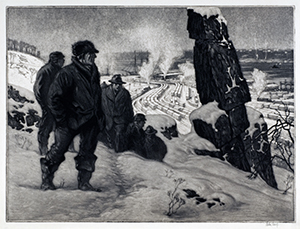
Martin Lewis (American, 1881-1962) Above the Yards, Weehawken, 1918 Aquatint and etching, 17 ½ x 23 ¼” Collection of Dr. Dorrance T. Kelly ©Estate of Martin Lewis
Martin Lewis (American, 1881-1962)
Above the Yards, Weehawken, 1918
Aquatint and etching, 17 ½ x 23 ¼”
Collection of Dr. Dorrance T. Kelly
©Estate of Martin Lewis

Highlighting the work of nine American artists who at the beginning of the twentieth century were inspired by the world around them to realistically depict everyday scenes, the Bruce Museum presents the new exhibition Telling American History: Realism from the Print Collection of Dr. Dorrance T. Kelly from August 31 through December 1, 2013.

The show features more than 40 original fine art prints including lithographs and etchings that chronicle daily life – the bustle of urban streets, boisterous moments of leisure, modern modes of transportation, and bucolic rural images – by leading artists who approached their subject matter through the lens of realism: George Bellows (1882-1925), Thomas Hart Benton (1889-1975), Edward Hopper (1882-1967), Martin Lewis (1881-1962), Reginald Marsh (1898-1954), John Sloan (1871-1951), Benton Murdoch Spruance (1904-1967), Stow Wengenroth (1906-1978), and Grant Wood (1891-1942).

The artworks present visitors with a snapshot of America from 1905 through 1967. Each print featured in the exhibition was chosen for its subject matter and artistic merit and placed together they present windows into scenes of America’s past. Set amid a backdrop of events such as World War I, the Great Depression, New Deal programs, and World War II, the country was experiencing changes in its cultural, geographic, and demographic nature. The nation experienced a great upheaval as citizens and immigrants alike flocked to urban areas in hopes of greater economic prospects. At the same time, advances in technology and transportation were transforming rural regions.

Wengenroth_Grand Central Stow Wengenroth (American, 1906-1978) Grand Central, 1949 Lithograph, 8 ½ x 15 ¾” Collection of Dr. Dorrance T. Kelly
Wengenroth_Grand Central
Stow Wengenroth (American, 1906-1978)
Grand Central, 1949
Lithograph, 8 ½ x 15 ¾”
Collection of Dr. Dorrance T. Kelly

Drawn from different areas of the country, the artists shared a similar goal of creating artwork that was available to all. They embraced realism, using it to capture images of modern American society as it quickly changed around them. This distinguished their work from the traditional, idealized and romanticized work of European art. By illustrating everyday scenes, the artists featured in this show created connections for the average American and invited them to become part of the artistic dialog,because their images appealed through accessible subject matter and to the pocketbook of the everyday person.

A fully illustrated catalogue of the show will be available in the Bruce Museum Store. A series of public programs will be offered to complement the show, including Monday morning lectures, hands-on printmaking workshops for adults and students, a program for families with toddlers and one for seniors suffering from memory loss, as well as school tours.

Lewis_Misty Night Martin Lewis (American, 1881-1962) Misty Night, Danbury, 1947 Lithograph,11 x 15 ¼” Collection of Dr. Dorrance T. Kelly ©Estate of Martin Lewis
Lewis_Misty Night
Martin Lewis (American, 1881-1962)
Misty Night, Danbury, 1947
Lithograph,11 x 15 ¼”
Collection of Dr. Dorrance T. Kelly
©Estate of Martin Lewis

About the Bruce Museum
Explore Art and Science at the Bruce Museum, located at One Museum Drive in Greenwich, Connecticut. The Museum is open Tuesday through Saturday from 10 am to 5 pm and Sunday from 1 pm to 5 pm; closed Mondays and major holidays. Admission is $7 for adults, $6 for students up to 22 years, $6 for seniors and free for members and children under 5 years. Individual admission is free on Tuesday. Free on-site parking is available and the Museum is accessible to individuals with disabilities. For additional information, call the Bruce Museum at (203) 869-0376 or visit the website at www.brucemuseum.org.

For area information www.visitfairfieldcountyct.com