“A Prairie Refrain” at Carole Peck’s Good News Cafe

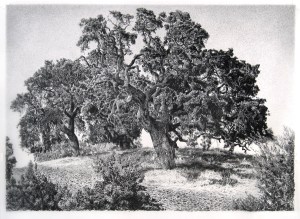
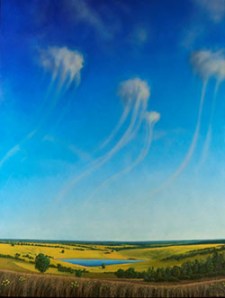
Contemporary realist painter, Karl Hartman, will exhibit his new show titled “A Prairie Refrain” through January 27, 2015 at Carole Peck’s Good News Cafe and Gallery, 694 Main Street South, Woodbury CT.

A_Prairie_Refrain

Hartman’s paintings focuses on his memories of the prairie landscapes that he grew to love and his evolvement with these landscapes as a geologist in Oklahoma, Texas and Kansas. Hartman describes this part of the United States as spare, quiet and infinitely dynamic, beautiful and terrifying all at the same time. In contrast to his painting of the plains, he is also working on drawings of Bergen County, New Jersey that reflect the tightly packed, crowded suburban local domestic world of this area as well as its occupants and their imprint on it.”

Karl Hartman was born in Billings Montana and grew up mostly in the plains states of Texas, Kansas and Oklahoma. He received his BS from the University of Oklahoma majoring in geology and minoring in art. He received his MFA in painting from the School of Visual Arts in New York where he studied with Sam Cady, Ursula von Rydingsvard and John Lees. He lives with his family in New Jersey and travels back to Oklahoma to see family, take photographs and sketch.

Karl shows at the Mary Ann Doran gallery in Tulsa, OK and the New Arts Gallery in Litchfield, CT. He has exhibited at the Kansas Museum of Fine Art in Wichita, KA, The Butler Institute of American Art in Youngstown, OH, The Charles A. Wustum Museum, Racine, WI. He has also shown at The Grand Central Galleries, The Adam Baumgold Gallery, and the National Academy of Design in New York as well as the Yoyogi School of fine art in Tokyo Japan.

His most recent award was the New Jersey State Council for the Arts Fellowship for painting. For area information visit http://www.litchfieldhills.com. For New Year or dinner reservations, contact Good News Cafe at http://www.good-news-cafe.com/

Small Works at the Carriage Barn in New Canaan

The Small Works! art exhibition at the Carriage Barn Arts Center runs through December 21 and highlights small scale art. The work on view by 50 artists, mainly from Connecticut and New York, range from delicate drawings, paintings, and photographs to finely crafted sculpture and ceramics. The juror of the exhibition is Lee Findlay Potter, Director of the David Findlay Jr. Gallery in New York, which specializes American painting and sculpture from the late 19th century to the present. Lee is the fifth generation of art dealers in her family and her father David Findlay is a long-time resident of New Canaan.

Birds, by  Isadora Lecuona Machado.
Birds, by Isadora Lecuona Machado.

Miniature works for the show were thoughtfully selected to provide a a historical and educational context for some of the contemporary art in the show. The history of miniature art goes back to the earliest periods of artistic production. The exhibition includes miniature manuscripts and Old Master prints, thereby tracing the evolution of such intimate gem-like works that require close examination. An early illuminated manuscript leaf exemplifies the painstaking attention to detail in medieval and early Renaissance devotional works. Two later examples of the highly sophisticated art of printmaking from the 1600s are Wenceslaus Hollar’s masterful etchings. Hollar, a leading 17th century Bohemian printmaker, made a notable series of tiny etchings after the Renaissance sketches in the renowned collection of Thomas Howard, Earl of Arundel, who intended to catalogue his drawings.

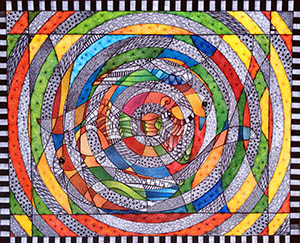
These early examples of miniature art are juxtaposed with contemporary works to provide a deeper understanding of their changing functions and meanings over time. The painting on an antique book cover by New York artist Holland Cunningham is contrasted with an early printed mathematical manuscript dated 1734 that has tiny decorative illustrations. Italian Renaissance paintings provide the inspiration for David Barnett’s assemblages in shadow boxes, notably the Madonna whose head with a golden halo is placed on a body made up of mechanical parts. Another re-interpretation of a Renaissance painting is Isadora Machado’s intricate pen drawing of the Mona Lisa. Machado’s elaborate and patterned drawings of moths and birds have the luminescent and decorative quality of early stained glass windows. Robbii Wessen’s assemblages of found organic and mechanical elements recall the imaginative objects from Renaissance cabinets of curiosity. Other such fanciful creations include the ceramic Pot Heads by Connie Nichols, literally tiny pots with whimsical heads on top.

The exhibition transitions to a group of abstract works, beginning with some examples of the recently deceased Sal Sirugo (1920-2013), who has been called “a hidden treasure of the Abstract Expressionist movement”. Sirugo began creating highly original works in the late 1940s, but while many of his Abstract Expressionist contemporaries worked on huge canvases, he preferred to work in more modest dimensions. His miniature ink drawings on paper have a mysterious, meditative quality that draw the viewer into his unique way of seeing.

To accompany this show, there will be a Children’s Art Workshop led by Nancy Scranton on December 7 and 14. The Gallery hours are Wed.-Sat., 10 am – 3 pm; Sunday, 1 – 5 pm. The gallery is located in Waveny Park, New Canaan. For more information, visit www.carriagebarn.org.

For area information www.visitfairfieldcountyct.com

Clare Romano & John Ross: 70 Years of Printmaking at Center for Contemporary Printmaking

The fall exhibition, featuring a sampling from the extensive collection of original prints by Clare Romano and John Ross, at The Center for Contemporary Printmaking (CCP), 299 West Ave., in Mathews Park, Norwalk, runs through Sunday, December 14, 2014.
Gallery visitors have the opportunity to view original prints made by these preeminent printmaking artists, educators, and authors—husband and wife, each with their own acclaimed individual careers—who have made the fine art of printmaking, with a particular emphasis on the art of the collagraph, their life’s work.

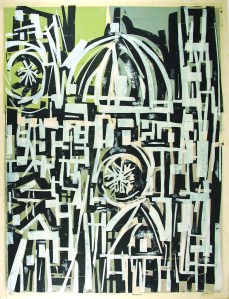
John Ross, "Duomo"
John Ross, “Duomo”

Clare Romano and John Ross had a major influence on the art printmaking and printmaking students. For many, their text, “The Complete Printmaker”, represented the next wave in printmaking. The exhibition showcases landscapes and cityscapes, lithographs, etchings, silkscreens, woodcuts, letterpress and, of course, collagraphs. Visitors will discover novel and innovative images using silk aquatint, asymmetrically cut plates, and the combination of intaglio and relief on the same plate.

The Center has scheduled an Artists Talk and Book Signing with John and Tim Ross for December 10 from 7 to 8:30 pm. Clare Romano and John Ross wrote and illustrated a number of books together, the first entitled Manhattan Island (1957) and the most important publication, The Complete Printmaker, originally published in 1972 is now in its second edition with Artist/Printmaker and Educator Tim Ross joining his parents as co-author. The Complete Printmaker is still used as a printmaking text in college classrooms today.

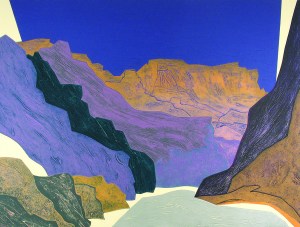
Clare Romano, "Silver Canyon"
Clare Romano, “Silver Canyon”

Normal hours are Tuesday through Sunday 9 am to 5 pm. The gallery is closed on Columbus Day, Veterans Day, and over the Thanksgiving Day weekend. Admission is free, and the gallery is handicapped accessible. For more information visit http://www.contemprints.org.

Delightful, Delicious, Disgusting: Paintings by Mia Brownell 2003-2013 at the Housatonic Museum of Art

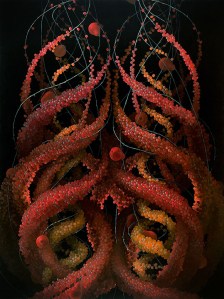
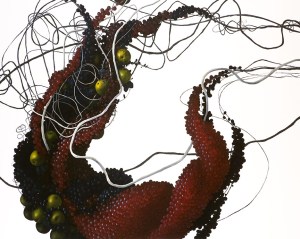
Twenty-eight of Mia Brownell’s paintings will be on display at the Housatonic Museum of Art in the Burt Chernow Galleries from through November 17, 2014. Luscious and sensuous, Mia Brownell’s paintings invite us to indulge in “earthly delights” and are themselves ripe with sexual innuendo.

SLwDoubleDoubleBIG

What Brownell asks us to contemplate is the brevity of life. “We begin in the madness of carnal desire and the transport of voluptuousness,” wrote the philosopher Arthur Schopenhauer, “we end in the dissolution of all our parts and the musty stench of corpses.” Seventeenth century Dutch still life paintings of tables laden with gastronomic delights served to remind viewers that all things perish but Brownell’s fruits invite us to relish the sweetness of now.

Although Mia Brownell’s paintings “may recall classical Vanitas paintings, her food-based compositions also invoke contemporary food politics. A critic of the food industrial complex, Brownell creates a juxtaposition between the natural and artificial, modeling her opulent still-lifes after molecular structures. Her depictions of shiny apples, bead-like caviar and juicy grapes look almost too good to be edible, hence the title of her upcoming traveling solo show, Delightful, Delicious, Disgusting.

SLwSweetDreamBIG

The exhibition, which premiered at J. Cacciola Gallery in New York, is a ten-year survey of Brownell’s paintings (2003-2013) travelled to the Hunterdon Art Museum in Clinton, New Jersey, Juniata College Museum of Art in Pennsylvania and the final stop at Housatonic Museum of Art in Connecticut.”

Gallery hours: Monday- Friday from 8:30am until 5:30pm, Thursdays until 7pm, Saturday from 9am until 3pm and Sunday Noon until 4pm. Please note that the Gallery will be CLOSED Monday. October 13th. For more information visit http://www.housatonic.edu/artmuseum/index.asp

Pastoral Solitudes and Landscape Paintings at the Gregory James Gallery

November 4th. All of the paintings were produced over the past two years and reflect the farms and untouched landscapes of Connecticut’s Northwest Corner. A few marine paintings were inspired by scenes near Adkins’ home in Maine, where as a boy, he spent summer vacations with his family.

Thomas_Adkins_Golden_Rod_Fields-Woodbury_24x24_oil_-

Most of his paintings are derived from small sketches made on location, which Adkins refers to later in the studio, making subtle changes in color and light to evoke a mood, the season or time of day.

The green and gold fields of “Northern Farm Early Spring” draw the eye up to an aging grey barn illuminated by sunlight peeking over the hills beyond the farm. The last remnants of snow are visible on hilltops and the bare branches of trees stretch toward a pale sky tinged with purple. The interplay of light and shadow hint at a scene captured just before sunset, or perhaps slightly after sunrise.

The change of season is evident in “Fall Diagonal Light Kent,” which features a pair of barns, bookends to a white farmhouse, tucked beneath leafy green trees tinged with orange. The last slanting rays of sun fall over the scene from beyond the frame of the painting as thick clouds move in from the opposite side.

Looking at “Lake Waramaug Summer,” the viewer seems to be perched on the path, in the same spot Adkins set up his easel, pausing to take in the view of the lake and green the hills sloping down to its edges. There is a small farm tucked into the hillside, yet there is a sense that the viewer is able to take in this tranquil scene alone. Adkins calls it “a snapshot of the moment. You get a true sense of the atmosphere and the feeling for the place.”

Thomas_Adkins_Fall_Diagonal_Light_Kent_30x40_oil_-

A graduate of Paier College of Art of New Haven, Adkins completed graduate classes at the School of Visual Arts of New York. He has worked as art director and creative director for some of the most prestigious advertising agencies in Connecticut and New York.

As a contemporary painter, Adkins’ style and technique has developed from early influences by Impressionistic painters of light on nature, such as Monet, Pissaro, Willard Metcalf. Adkins’ work is featured in private collections throughout the United States and abroad. His paintings have been shown in galleries and exhibitions in Connecticut and New England, including the New Britain Museum of American Art, The Butler Institute Of American, Old Lyme Association, Gregory James Gallery, Greene Art Gallery and at Bayview Gallery in Brunswick, Me. A member of the Connecticut Plein Air Painters Society and the Association of Oil Painters of America, he participated in the prestigious International Marine Art Exhibition at The Maritime Gallery at Mystic Seaport. In 2014, he will be one of a select few award-winning artists from seven countries selected to participate in the 35th Annual International Marine Art Exhibition at Mystic Seaport.

The Gregory James Gallery is located at 93 Park Lane Road (Route 202) in New Milford, about 100 feet from the intersection of Route 109. For more information, please call (860) 354-3436 or visit gregoryjamesgallery.com.

Michael Quadland “Recent Work- Metallic” in Litchfield

The Oliver Wolcott Library in the heart of Litchfield is hosting the work of Michael Quadland through October 24. The Library located on 150 South Street in Litchfield adjoins the historic house that once belonged to Oliver Wolcott Jr. and was built by Elijah Wadsworth in 1799.

oxczgf2YVHet-6OYDiaetBwZNnQc4tlavbKkRgV9-oo,nx3vs6Yuz9Tpk98563OwxSF53UgBntquvXjEoPW7RFM

Elijah Wadsworth sold the estate to Frederick Wolcott in 1800 Oliver Wolcott, Jr. acquired the house in 1814 and enlarged it considerably in 1817. Mrs. Oliver Wolcott (Elizabeth Stoughton) was known for being a gracious hostess and the fame of her parties reached as far as Washington, D.C. and England. Parties were frequently held in the ballroom on the second floor. It is said that President George Washington danced his last minuet in Litchfield in that ballroom. The ballroom was restored by the Society of Colonial Wars and can be viewed upon request.

q4_9MQdf3PxAWTrL916baIBOF82cRvXUKtJxWQIzz88,dQ59l0Gc1rdcexbG9lTXxZ6ftDU1Xs3usRsGi0emNJE

The artwork on display by Quadland focuses on the expression of emotion. One of the things he enjoys most about painting is the process of putting feelings into visual form, having depended on words for so many years, professionally. He has chosen a nonobjective format as a way to maximize imagination and projection, using abstract forms and evocative colors in layered surfaces. It is difficult for anyone seeing his work not to respond with some sort of feeling. The layers and traces of his paintings contain secrets, he says, that can be revealed to the viewer over time. In this way, the work retains interest, is perpetually new.

yOcCNEdAYOFC3J9Ie9u_hMK2ZhGdr98g8njoDnX78FY

In this “Recent Work” series at Oliver Wolcott Library, Michael’s painting assumes the feeling, texture and dimensionality of sculpture or architecture. Indeed, it seems to straddle the line between these disciplines and painting. Metallic surfaces appear to have been cast eons ago, or to have been torn from a demolished building, the metal having corroded into rough and gritty surfaces, evoking a long, arduous, even mysterious past.

For more information about the Oliver Wolcott Library http://www.owlibrary.org.