Being, Nothingness and More: Roz Chast Beyond the New Yorker at the Bruce Museum

The Bruce Museum located on One Museum Dr. in Greenwich is presenting a new exhibiton of 30 works by the well known Roz Chast. A highlight of this exhibition will be examples of of Chast’s iconic work from The New Yorker magazine, as well as prints and drawings from other projects. Also on display will be tapestries and painted eggs in the pysanky tradition decorated with the artist’s signature images. The Show runs through October 19.
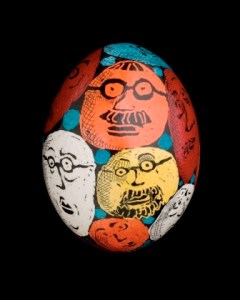
Roz Chast Painted Egg © Roz Chast
Roz Chast
Painted Egg
© Roz Chast

Roz was born in Flatbush Brooklyn and graduated from the Rhode Island School of Design. Her cartoons first began appearing in New York City in publications includingThe Village Voice.
Since the late 1970s, her work has been featured frequently in The New Yorker, and in 1986 her work was featured on the cover of that magazine for the first time. She has written or illustrated more than a dozen books, includingUnscientific Americans, Parallel Universes, Mondo Boxo, Proof of Life on Earth, The Four Elementsand The Party After You Left: Collected Cartoons 1995–2003 (Bloomsbury, 2004). In 2006,Theories of Everything: Selected Collected and Health-Inspected Cartoons, 1978–2006 was published, collecting most of her cartoons from The New Yorker and other periodicals.

Roz Chast Peas and Carrots Textile © Roz Chast
Roz Chast
Peas and Carrots
Textile
© Roz Chast

Her most recent book, Can’t We Talk About Something More Pleasant (published in May), chronicles her relationship with her parents as they each approached the end of life.

The Bruce Museum is open Tuesday – Saturday 10 am – 5 pm, Sunday 1 pm – 5 pm, Doors close 1/2 hour before closing, and the last admission 4:30 pm. For more information about the Bruce Museum visit www.brucemuseum.org

Summer exhibitions at the Mattatuck Museum Waterbury

This summer, the Mattatuck Museum in Waterbury Connecticut is presenting an art show called Haven and Inspiration that runs through August 24. This fascinating exhibition traces the evolution of the Kent Connecticut Art Colony.

Nichols-1

Haven and Inspiration explores the wide range of artistic styles and subjects produced by the art colony’s founding members: Rex Brasher (1869-1960) Eliot Candee Clark (1883-1980), Carl Hirschberg (1854-1923), Francis Luis Mora (1874-1940), G. Laurence Nelson (1887-1978), Spencer Baird Nichols (1875-1950), Robert Nisbet (1879-1961), Willard Paddock (1873-1956) and Frederick Judd Waugh (1861-1940). Of all the villages in Connecticut, Kent attracted the most permanent colony of artists and developed the only artists’ organization that exists to this day. It remains, until now, however, the one least examined.

Building upon the scholarship of Robert Michael Austin, whose publication, Artists of the Litchfield Hills devotes a chapter to the Kent Art Colony, this exhibition focuses on the period 1910 to 1930. Robert Nisbet moved to Kent in 1910; shortly after, like-minded artists who started as visitors became neighbors. By the summer of 1922, there were enough artists in Kent for them to consider organizing into a group. While landscape was the primary subject, they also painted portraits, genre scenes and still lifes.

Magna steel Magnolias5056

Another exhibition at the Mattatuck, The Way We Worked that runs through August 3 explores how ork became a central element in American culture by tracing the many changes that affected the workforce and work environments. The exhibition draws from the Archives’ rich photographic collections, covering more than 150 years to tell this compelling story. Why, where, and how do we work? What value does work have to individuals and communities? What does our work tell others about us?

Included in this exhibit are paintings by Anna Held Audette and Duvian Montoya. Audette is a contemporary woman artist who paints industrial ruins and abandoned machinery and Montoya’s painting’s act as a personal journal of observations made during his travels, childhood, and life experiences.

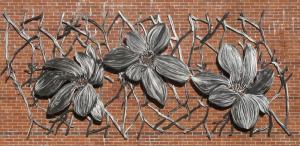
A third exhibition that runs through August 31 and is titled Steel Garden showcases the work of Sculptor Babette Bloch. Considered a is a pioneer in the use of laser-cut and water jet-cut stainless steel in creating works of art, Bloch’s sculptures explore form and the interplay between object and light, reflect their environments, and expand the ways in which stainless steel is used in contemporary art.
Bloch’s works of art embrace her eclectic tastes, her pleasure in aesthetics and her technical curiosity. Drawing on several traditions in American art, she creates works that touch on Modernist abstraction, the cut outs and collage found in Pop art, and the long-standing practice of storytelling in art. In cutting, shaping, burnishing, and grinding stainless steel, Bloch has developed the material’s natural properties of brightness and reflectivity while making the dense metal seem nearly weightless and ethereal.

shoes

A not to be missed continuing exhibition, Fancy This: The Gilded Age of Fashion displays beautiful, rarely seen costume pieces from the Mattatuck’s collection. Many of these delicate objects have not been on view for decades. Guest curator Mary Daniel is the winner of the 2013 Summer Fling “Curator for the Day” auction prize and has been working with the Museum’s curatorial department to organize this exhibition which also includes accessories such as shoes, purses, fans and gloves.

The Mattatuck Museum is located on 144 West Main Street, Waterbury CT. The museum is open Tues. – Sat. 10 a.m. – 5 p.m., Sundays from 12 noon to 5 p.m. and open late the first Thursday of the Month until 7:30 p.m. For additional information https://www.mattatuckmuseum.org.

For information about the Litchfield Hills www.litchfieldhills.com

Westport Arts Festival July 19 & 20

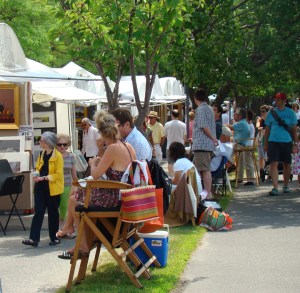
This year marks the 41st for the popular Westport Arts Festival that is taking place this year in the center of Westport in Parker Harding Plaza and on Gorham Island on July 19 from 10 a.m. to 6 p.m. and on July 20, from 10 a.m. to 5 p.m.

07

Festival goers can expect original juried works in Painting, Watercolor, Photography, Sculpture, Drawing, Printmaking, Mixed Media, Glass, Ceramics, Fiber, Jewelry, Wood and Digital Art dispayed along the lovely Saugatuck River in the heart of this charming riverside community.

02

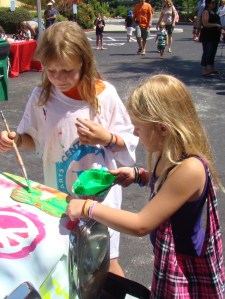
Best of all, visitors will experience more than just the visual arts at the Westport Fine Arts Festival: there will be unique street performances, live music, hands-on art activities, and delicious food from local restaurateurs. As for kids, they will enjoy the special Beach Bonanza Children’s Tent Zone provided by the Westport Arts Center. This area will feature both collaborative and individual hands-on projects, all with a seashore inspired theme! From string murals to large-scale jellyfish, kids will be sure to have a blast; just look for the the palm trees to find the Kid Zone.

kids2

As for entertainment, there is plenty with an exciting line up as follows:

Saturday July 19
10:15 – 11:30 Chris MacKay and the Tone Shifters

11:45 – 1:00 Shiny Lapel Trio

1:15 – 2:30 Paul Brockett Roadshow Band

3:00 – 4:30 Mill River Band

5:00 – 6:30 Dr. B and The Brotherhood

Sunday July 20

10:15 – 11:30 Josi Davis and Hot Damn!

11:45 – 1:00 Pete Herger Band

1:30 – 2:45 Dylan Conner

3:10 – 4:30 Washboard Slim and the Bluelights
For More information visit www.westportfineartsfestival.com. For area information www.visitfairfieldcountyct.com

Pasture to Pond: Connecticut Impressionism

Pasture to Pond: Connecticut Impressionism at the Bruce Museum in Greenwich, CT, runs through June 22, brings American Impressionism back to its roots, according to the Museum’s Executive Director, Peter C. Sutton.

Metcalf_Autumn  Willard Leroy Metcalf, (American, 1858-1925)
Metcalf_Autumn
Willard Leroy Metcalf, (American, 1858-1925)

“The history of art proves that Connecticut has long been one of the most fertile states for the creation of new art movements,” says Peter Sutton. “In no small measure it was the birthplace of American Impressionism.”

Drawn from the permanent collection of the Bruce, private collectors, area museums, and the trade, this exhibition of more than 25 works of American Impressionism speaks to the quality and beauty of this perennially popular art, and to Connecticut’s important role in its creation.

Before the turn of the 20th century, Connecticut was a logical birthplace for American Impressionism, as artists sought a nearby, rural respite from the burgeoning urban and rapidly industrializing world. While their artistic predecessors, the landscape painters of the Hudson River School, had championed dramatic landscapes of panoramic sweep and awe-inspiring majesty, the artists who came of age after the calamity and chaos of the Civil War sought a more intimate, bucolic and orderly landscape. They found these reassuring views among the farms, rolling hills, rivers and picturesque shoreline of Connecticut.

 Davis_Uplands  Charles H. Davis, (American, 1856-1933)
Davis_Uplands
Charles H. Davis, (American, 1856-1933)

While steeped in pre-Revolutionary history, Connecticut was readily accessible by train to these escaping urbanites, many of whom had winter studios in New York City. Artists’ colonies sprang up in Cos Cob and Old Lyme and landscapists took to recording favored sites in places like Branchville, Farmington, Mystic and the Litchfield Hills. The names of these artists – John H. Twachtman, J. Alden Weir, Childe Hassam, and Willard Metcalf – are among the most famous landscapists in American art history. While some, like Robinson, made regular pilgrimages to France to paint alongside the great French Impressionist Claude Monet, others learned the style second hand, and collectively they made it a uniquely American manner.

“Several of the artists featured in the show exhibited in the famous Armory Show in New York in 1913, which is generally regarded as the watershed moment that introduced Modern Art and the likes of Marcel Duchamp to America,” says Peter Sutton. “It is with pleasure then that we remember with this exhibition an era of enduring local creativity and the celebration of the beauty of our own special corner of New England.”

Pasture to Pond: Connecticut Impressionism is generously underwritten by People’s United Bank, a Committee of Honor co-chaired by Leora Levy and Alice Melly, a grant from the Connecticut Office of the Arts, and The Charles M. and Deborah G. Royce Exhibition Fund.

_Crane_Harvest Moon  Bruce Crane, (American, 1857-1937)
_Crane_Harvest Moon
Bruce Crane, (American, 1857-1937)

And when you go, don’t forget your cell phone: This exhibition, like many others at the Bruce, will be accompanied by a compelling cell phone audio tour guide program, Guide by Cell, generously underwritten by Nat and Lucy Day. The Guide by Cell program for Pasture to Pond: Connecticut Impressionism will include a driving tour of sites in Greenwich that are featured in some of the paintings on view. Easy to follow Guide by Cell instructions will be available at the front admissions desk, and in the case of this exhibition will include a physical map for the driving tour.

About the Bruce Museum

The Bruce Museum of Art and Science is located at One Museum Drive in Greenwich, Connecticut. The Museum is open Tuesday through Saturday from 10 am to 5 pm and Sunday from 1 pm to 5 pm; closed Mondays and major holidays. Admission is $7 for adults, $6 for students up to 22 years, $6 for seniors and free for members and children less than five years. Individual admission is free on Tuesday. Free on-site parking is available and the Museum is accessible to individuals with disabilities. For additional information, call the Bruce Museum at (203) 869-0376 or visit the website at www.brucemuseum.org.

Journey to a Magical Cloud Forest- A Quiet Place at the Oliver Wolcott Library and White Flower Farm

The Oliver Wolcott Library on 160 South Street in Litchfield is hosting the photographs of Sue Kennedy through April 25 in the Gallery of this lovely library.

Twenty years ago Sue Kennedy was in Texas working on a Kinesiology and Adapted Physical Education PhD. If anyone had told her that photographing and raising orchids was what she would be doing today, she wouldn’t have believed them. She is here to share her journey, and hopes you will smile, find joy, and most of all, peace from these images of her quiet and powerful children of the Magical Cloud Forest.

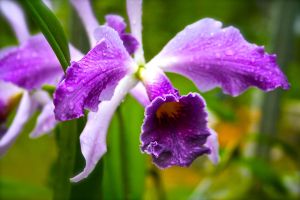
Blue Cattleya

Sue’s father was a pediatrician in the Torrington/Litchfield area, but he always had a second great passion…orchids. Before medical school he earned a PhD in Botany from Cornell and dreamed of discovering and naming a new orchid. After retiring from medicine and armed with a U.S. Department of Agriculture permit, he and his wife took many collecting excursions including the Amazon, Peru, Ecuador, Mexico, Venezuela, Costa Rica, and Nicaragua. Plants were brought home, potted or mounted, and treasured in his “quiet place,” the greenhouse he had built.

OWL-_Sue_Kennedy_1__Mar-Apr_2014

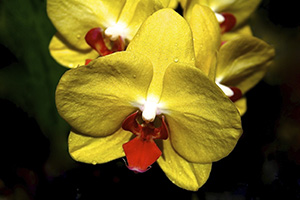
When her father passed away and her mother became ill, Sue was forced with a dilemma – let the orchids die, sell them off or give it a go. She dove in and never looked back. With each blossom she began to see and photograph the unique character of each plant. She shared her images with friends and would see their eyes light up with a kind of childish wonder, peace and joy. Sue continues to capture how light is reflected and penetrates; how it enlightens; how each bloom is a fascination.

SlideShowv2_image1

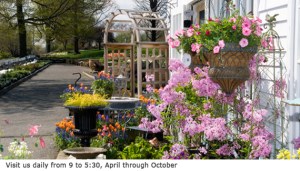
After visiting the Library, stop by White Flower Farm to look at the fabulous selection of plants to be found there. White Flower Farm is located on Rte. 63, 167 Litchfield Rd. a few miles south of the center of Litchfield. Visitors to White Flower Farm will find a wide array of plants for sale. The shop at White Flower Farm opens in April. Visitors may also explore several beautiful display gardens that are adjacent to the shop. For more information about White Flower Farm visit www.whiteflowerfarm.com.

For more information on programs at the Oliver Wolcott Library call 860-567-8030 or www.owlibrary.org For information on Litchfield Hills www.litchfieldhills.com

Cover Story: The New Yorker in Westport at the Westport Historical Society

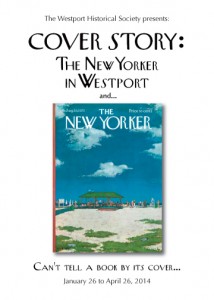
The Westport Historical Society located on 25 Avery Place in Westport is hosting an exhibit, Cover Story: The New Yorker in Westport and “Can’t Tell a Book by its Cover…” through April 26.

CoverStory-214x300

This exhibition focus’s on the fact that between 1925 and 1989, 13 New Yorker artists living in and around Westport-Weston produced a remarkable 695 covers for The New Yorker Magazine. Some 44 of the covers actually depict Westport scenes.

These two exhibits share the covers and the story-behind-the-story, focusing on the influence of The New Yorker’s “idea man” turned Art Editor , James Geraghty, who–with wife Eva–first lived on Rayfield Rd, Westport before moving to Old Redding Rd. in Weston. Throughout the Geraghty era (1939 to 1973), often with an element of wit, The New Yorker’s cover images mirrored the commuter lifestyle of his Connecticut-based artists, including Garrett Price, James Daugherty, Perry Barlow, Alice Harvey, Helen Hokinson, Edna Eicke, Arthur Getz, Reginald Massie, Whitney Darrow, Jr., Charles Saxon, Albert Hubbell, Donald Reilly and John Norment. Curator Eve Potts draws from artifacts, anecdotes and correspondence provided by the families of Geraghty and these artists, who also did innumerable drawings for the magazine.

Never, as visitors will see in “Can’t Tell a Book by its Cover…” in the Mollie Donovan Gallery, was that more true than the Aug. 31, 1946 New Yorker, a single-story issue. The story? Hiroshima, by writer John Hersey, who shortly thereafter moved to Turkey Hill South (the home later sold to Andy & Martha Stewart) in Westport.

Hersey , considered the “Father of the New Journalism,” not only was a member of Geraghty’s local New Yorker Friday afternoon bowling team (Westport Bowling Lanes, in winter) and golf team (Longshore, in summer), he served for a period of time on the Town of Westport Board of Education.

The Westport Historical Society is open Monday – Friday 10 – 4 p.m.and Saturday 12 – 4 p.m. For more information http://westporthistory.org. For information on Fairfield County www.visitfairfieldcountyct.com