Westport’s Hidden Garden Tour

Be sure to mark Sunday, June 8th, on your calendars, garden lovers. That’s the day the Westport Historical Society rolls out its annual Hidden Garden Tour of five exceptional properties in Westport and Fairfield, and a Garden Market on the town’s Veterans Green, followed by a gala Garden Party that evening under a festive tent also on Veterans Green.

weblogotulip-1

Among the gardens to be showcased on the self-guided tour is one its owners say “has put the green in Greens Farms.” And another at a land-marked house that once belonged to George Hand Wright, dean of Westport’s art community from 1907 to 1951. Green-thumbs can learn how others deal with such problems as nibbling deer, large swaths of shade, and variations in dry and wet soil.

The five venues of the Garden Tour will offer visitors the opportunity to connect to nature will all their senses. Garden experiences will include musicians, old-fashioned croquet, moving meditation demonstrations, food and beverage tastings, and garden experts.

Here’s an overview of this year’s five featured gardens:

Discovery and Restoration: Quite overgrown when the current owner moved there in 2010, George Hand Wright’s 1767 house sits on a spacious tract bounded by native stone walls. Scattered about are specimen trees: a Japanese katsura, Zelkova elm and towering Norway maple in the front, old apple trees and newer cherry trees in the side yard, and a weeping cherry and star magnolia near the drive. The flower beds are planted in blue tones favored by the owner and include blue hydrangeas, Russian sage, and butterfly bush. Behind the house, the lawn slopes to a restored pond and wetlands. An added treat is the secret garden behind the painter’s studio that was unearthed when the owner discovered “a mysterious brick stairway that seemed to go nowhere.”

Greenfield Hill Gem: This 1824 Dutch-style house atop Greenfield Hill has quite a pedigree. It occupies land first settled by the ancestors of the owner’s late husband in the 1600s. In 1976, when the couple moved in, they inherited an English rose garden designed by the firm of Frederick Law Olmstead, the creator of New York’s Central Park. Though no longer planted in roses, the garden’s format remains unchanged, its beds enclosed in stone walls and sharing space with boxwoods and a pond.

Inspiration of Roses: Possessing little sophistication when its current owners arrived in the late 1990s, this home and garden in the Gorham Avenue Historic District near downtown Westport was nevertheless redeemed by “good bones.” So the couple, who both came from gardening families, set to work creating their own landscape, inspired by the six David Austin roses received as a housewarming gift. The centerpiece is a magnificent Japanese maple surrounded by a shade garden comprised of hosta, ferns, and Japanese forest grass. The sunnier areas show off borders of lamb’s ear, stonecrop, peonies, irises and lilies, and beds of lily of the valley, bloodroot, and imperata. Expect to see some bees as the owners are beekeepers as well as gardeners.

Continuous Blooming Color: Owned by landscape architects in the Stratfield section of Fairfield, this property is defined by the presence of old-growth trees whose dense canopy has forced the owners to use shade- tolerant plants. Even so, they have managed to provide color and bloom time from March to October using perennials, spring flowering lawn and garden bulbs, and flowering bushes and trees. A garden of wetland grasses and flowering native plants peeks from behind a 100-year-old spring-fed swimming pool. And a rock ledge beside the home is populated by daffodils, crocus, hosta, azalea, rhododendron, and woodland geranium.

Summer Hill Bliss: At this garden on a private Green’s Farms cul-de-sac, the plantings were inspired by the New York Botanical Garden and embellished by the owners’ love of wordplay. The formal garden is divided into three rooms, one with free-form beds divided by “a boulevard of grass” and another that the owners describe as a tranquil space with an alley. They call it their Zen Central. The pool/patio area features a white garden that changes with the seasons.
Hours for the Garden Tour are 11am to 4pm. Ticket prices are $40 for WHS members, $50 for non-members, and $55 if purchased on the day of the tour. A jitney service will be available to the gardens at an additional $20 per person. To reserve a seat, those interested should call Sue at 203-222-1424.

Tour-goers can start or finish their rounds by checking out the Garden Market on Veterans Green, adjacent to WHS headquarters. A variety of practical and fanciful items for home and garden will be for sale including plants, garden tools, antiques, jewelry, and accessories. Admission is free. Following the garden tour and market will be the Garden Party, also on Veterans Green, from 6:30 to 9:00. Guests will enjoy delicious hors d’oeuvres and beverages provided by local restaurants and caterers, silent and live auctions, while listening to live jazz.

Tickets are $50 per person. Tickets for the Garden Tour and Garden Party may be purchased online at https://westporthistory.securesites.com/products/index.php?type=883&PCID=883:0:0:0:0 , or by visiting or calling Westport Historical Society, 25 Avery Place, 203- 222-1424 across from Westport Town Hall. Tickets and garden directions will be available for pick up Sunday, June 8th from 10am to 2pm at the Garden Market.

Jiggle a Jelly at the Maritime Aquarium Norwalk

Apparently it’s a lot of fun to touch jellyfish when you know you won’t be stung. “Jiggle A Jelly” has become a permanent offering at The Maritime Aquarium at Norwalk. The display, will now will be open on weekends, holidays and school-vacation days through June 30, and then daily in July and August. It’s free with Aquarium admission.

Aquar.JiggleAJelly

Visitors will be able to experience the unusual sensation of touching jellies making Jiggle A Jelly’ one of the Aquarium regular hands-on features, along with their Intertidal Touch Tank and our Shark & Ray Touch Pool.

Visitors can safely touch live moon jellyfish, one of the most common species in Long Island Sound. Maritime Aquarium volunteers staff the exhibit, encouraging visitors to use two fingers to gently touch the top of the jellyfishes’ gelatinous body or “bell.”

Moon jellies (Aurelia aurita) do have tentacles but their stings are generally benign to people. A common species in Long Island Sound, they grow to dinner-plate size during the warmth of summer. Short tentacles rim their bell, and four “oral arms” extend underneath. Moon jellies are colorless and translucent, except for four central horseshoe-shaped reproductive organs.

Aquar.JIggleAJelly2 (1)

Letting visitors get close to jellyfish is nothing new for The Maritime Aquarium. A mesmerizing gallery featuring moon jellies, sea nettles, lion’s mane and other live species of jellyfish is now in its 19th year at the Aquarium and remains among the most popular and memorable exhibits.

Plus, displays of jellies in their various life stages in the Jellyfish Culture Lab let visitors see how the Aquarium keeps a year-round supply of the seasonal creatures on exhibit. But “Jiggle A Jelly” is the first time visitors have been able to touch them.

Learn more about the Aquarium’s exhibits, IMAX® movies and programs at www.maritimeaquarium.org or by calling (203) 852-0700. For information about Fairfield County www.visitfairfieldcountyct.com

Arthur Carter at Washington’s Stairwell Gallery

The Stairwell Gallery at Gunn Memorial Library in Washington, CT is honored to present an exhibition of sculptures, orthogonals and paintings by Arthur Carter. The exhibit will be on view through June 21.

Arthur_Carter_-_Studio_in_Roxbury,CT_photo_taken_by_Maggie_Nimkin_2008

Mr. Carter’s early years might seem like another person’s full lifetime of events. He was trained as a classical pianist, majored in French literature at Brown University, served three years in the United States Coast Guard as a lieutenant commanding officer of an air search and rescue craft, then received his MBA in finance from Dartmouth, followed by a 25 year career as an investment banker.

In 1981, he started a new venture. Founding the Litchfield County Times and six years later the New York Observer, he began his career as a publisher. He was also the publisher of theNation and the East Hampton Star. And in 2008, the Arthur L. Carter Journalism Institute was founded at New York University where Mr. Carter is a trustee and chairman of the Board of Overseers of the Faculty of Arts and Science. Mr. Carter has also held adjunct professorships in philosophy and journalism at NYU.

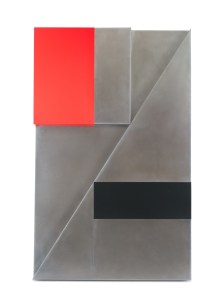
Orthogonal_Construction_15,_2010_-_Acrylic_on_Stainless_Steel_48_X_30_in

Now we come to the “art part” of Mr. Carter – the grid design and layout of the front page of his newspapers inspired him to reproduce that same theme but in a three dimensional format and using stainless steel. This was a material he had learned to master when he was in Officer Candidate School where he learned welding. Thus, sculpting “became the latest statement of his polymath proclivities.”

Artists naturally evolve and he was soon working with wood, clay and copper wire and then larger constructions in silicon bronze and stainless steel. Many of his larger pieces are on permanent public display in New York City. The fabrication process can take months to complete and involves all the complexities of a machine shop, but each piece begins with one common denominator, his sketch pad.

The Stairwell Gallery exhibit will include Mr. Carter’s Orthogonals. A catalog of his exhibit at the New Britain Museum of American Art from the Fall of 2011, describes the pieces as follows: “Arthur Carter’s bold new series, which he calls collectively the Orthogonals, offers a fine example of a mixed mode that channels the powers of painting and sculpture through the distinguished medium of the relief.” These pieces are complex in their simplicity. They are strong, mathematical and like his other work, they vary in finish and are affected by the changing light and reflection. Carter has said, “My work focuses on simplifying and eliminating the excessive. The question is how does purity of design lend itself to making a beautiful and elegant piece?”

Untitled_No._1_-__2013_-_Bronze,_36_X_24_X_14_inches

Arthur Carter maintains a production facility and design studio in Roxbury, CT. He has been a featured solo artist at many galleries, including the Tennessee State Museum, The Grey Art Gallery, 80WSE Galleries at New York University and the New Britain Museum of American Art. Mr. Carter is the author of two hardcover books, Arthur Carter: Sculptures, Paintings, Drawings (2009) and Arthur Carter: Studies for Construction (2012).

Gunn Memorial is most pleased to welcome this prolific artist who is still immersed in the world of manufacturing and finance around the world. Perhaps his philosophy can help unify this “polymath” for us. Mr. Carter has said, “The simpler the economics are, the better; if you don’t understand it, you don’t do it. Purity in both design and business function means never dilute, never diffuse, and never bloat.”
For further information please call (860) 868-7586 or email chartman@biblio.org . The Gunn Memorial Library is located at 5 Wykeham Road at the juncture of Route 47 opposite the Green in Washington, CT. For library hours and to learn more about our programs and events visit our website www.gunnlibrary.org .

For information on Litchfield Hills www.litchfieldhills.com

Pasture to Pond: Connecticut Impressionism

Pasture to Pond: Connecticut Impressionism at the Bruce Museum in Greenwich, CT, runs through June 22, brings American Impressionism back to its roots, according to the Museum’s Executive Director, Peter C. Sutton.

Metcalf_Autumn  Willard Leroy Metcalf, (American, 1858-1925)
Metcalf_Autumn
Willard Leroy Metcalf, (American, 1858-1925)

“The history of art proves that Connecticut has long been one of the most fertile states for the creation of new art movements,” says Peter Sutton. “In no small measure it was the birthplace of American Impressionism.”

Drawn from the permanent collection of the Bruce, private collectors, area museums, and the trade, this exhibition of more than 25 works of American Impressionism speaks to the quality and beauty of this perennially popular art, and to Connecticut’s important role in its creation.

Before the turn of the 20th century, Connecticut was a logical birthplace for American Impressionism, as artists sought a nearby, rural respite from the burgeoning urban and rapidly industrializing world. While their artistic predecessors, the landscape painters of the Hudson River School, had championed dramatic landscapes of panoramic sweep and awe-inspiring majesty, the artists who came of age after the calamity and chaos of the Civil War sought a more intimate, bucolic and orderly landscape. They found these reassuring views among the farms, rolling hills, rivers and picturesque shoreline of Connecticut.

 Davis_Uplands  Charles H. Davis, (American, 1856-1933)
Davis_Uplands
Charles H. Davis, (American, 1856-1933)

While steeped in pre-Revolutionary history, Connecticut was readily accessible by train to these escaping urbanites, many of whom had winter studios in New York City. Artists’ colonies sprang up in Cos Cob and Old Lyme and landscapists took to recording favored sites in places like Branchville, Farmington, Mystic and the Litchfield Hills. The names of these artists – John H. Twachtman, J. Alden Weir, Childe Hassam, and Willard Metcalf – are among the most famous landscapists in American art history. While some, like Robinson, made regular pilgrimages to France to paint alongside the great French Impressionist Claude Monet, others learned the style second hand, and collectively they made it a uniquely American manner.

“Several of the artists featured in the show exhibited in the famous Armory Show in New York in 1913, which is generally regarded as the watershed moment that introduced Modern Art and the likes of Marcel Duchamp to America,” says Peter Sutton. “It is with pleasure then that we remember with this exhibition an era of enduring local creativity and the celebration of the beauty of our own special corner of New England.”

Pasture to Pond: Connecticut Impressionism is generously underwritten by People’s United Bank, a Committee of Honor co-chaired by Leora Levy and Alice Melly, a grant from the Connecticut Office of the Arts, and The Charles M. and Deborah G. Royce Exhibition Fund.

_Crane_Harvest Moon  Bruce Crane, (American, 1857-1937)
_Crane_Harvest Moon
Bruce Crane, (American, 1857-1937)

And when you go, don’t forget your cell phone: This exhibition, like many others at the Bruce, will be accompanied by a compelling cell phone audio tour guide program, Guide by Cell, generously underwritten by Nat and Lucy Day. The Guide by Cell program for Pasture to Pond: Connecticut Impressionism will include a driving tour of sites in Greenwich that are featured in some of the paintings on view. Easy to follow Guide by Cell instructions will be available at the front admissions desk, and in the case of this exhibition will include a physical map for the driving tour.

About the Bruce Museum

The Bruce Museum of Art and Science is located at One Museum Drive in Greenwich, Connecticut. The Museum is open Tuesday through Saturday from 10 am to 5 pm and Sunday from 1 pm to 5 pm; closed Mondays and major holidays. Admission is $7 for adults, $6 for students up to 22 years, $6 for seniors and free for members and children less than five years. Individual admission is free on Tuesday. Free on-site parking is available and the Museum is accessible to individuals with disabilities. For additional information, call the Bruce Museum at (203) 869-0376 or visit the website at www.brucemuseum.org.

Monroe’s Rails Trails Tour

On Saturday, May 31 the Monroe Historical Society is offering a look back to the Golden Age of Railroading for its annual spring glimpse into the past and is offering the newly revamped Rails Trails Tour.

2013steamtrain

The Rails Trails Tour covers the sites of four old wooden railway stations once vital to the rhythm of life in Monroe-Stepney and Stevenson Depots, and will also include Pepper Crossing and a stop off at Hammertown Road, known simply as Monroe Station.

Participants will board a motorcoach that will depart from the Monroe Senior Center on 235 Cutler’s Farm Rd. in Monroe at 10 a.m. Box lunches will be for sale as there is a noon stopover for lunch in Wolfe Park. There is also a ten-minute screening of the Great Train Robbery produced by Thomas Edison Studios in 1903 that will be shown before the motor coach departs and after it returns. This is the first commercially viable movie with sequential scenes.

The tour will include two morning stops and two stops in the afternoon and the motorcoach will head out rain or shine. Due to safety considerations, no private automobiles, motorcycles or bicycles are permitted on the tour. A special highlight of each tour will be the illustrated presentations at each site by railway historians: John Babina, Bob Belletzkie and Monroe’s town historian, Ed Coffey.

Displays will show how the steam engine was the lifeline for distributing farm products that drove the Monroe economy in the 1840s. At this time, the rail lines were the primary link to the outside world with its jobs and high schools in Bridgeport. The rail line also gave Monroe’s merchants access to goods and brought the farmers supplies like seed, fertilizer, feed and agricultural machinery.

With the advent of the automobile, by the 1930s passenger service was virtually discontinued. At the same time trucks became a more dedicated alternative for transporting the needs of business although limited use of the tracks for commerce continued until recent years.

The cost of the Rails Trails Tour is $10 for members, $15 for non-members, discounted to $5 for seniors and students. Tickets are available at the Monroe Senior Center and the Edith Wheeler Memorial Library. Space is limited. Additional information is available from Marven Moss at mmoss36@yahoo.com

The Charlie Daniels Band with The Artimus Pyle Band at The Warner Theatre

-Infinity Hall will present The Charlie Daniels Band with The Artimus Pyle Band on Thursday, May 29, 2014 at the Warner Theatre. This is the onlyCT/New England stop for the band this spring.

Warner Theatre
Warner Theatre

Award-winning musician Charlie Daniels has successfully crossed musical genres in a way few artists have accomplished – from his Dove Award winning gospel albums to his genre-defining Southern rock anthems and his CMA Award-winning country hits. In 1994, for instance, he released his first Christian album, The Door, on Sparrow Records. The album won the Gospel Music Association’s Dove Award for Best Country Album and “Two Out of Three” was named video of the year by the Christian Country Music Association. In 1997, Sony Wonder released Charlie’s first children’s album, By The Light of The Moon, Campfire Songs and Cowboy Tunes. Over the course of his career, Charlie has received numerous accolades, including induction into the Grand Ole Opry and Musicians Hall of Fame. He’s been presented the Pioneer Award by the Academy of Country Music and was honored as a BMI Icon in recognition of his songwriting. He has also received a star on the Music City Walk of Fame.

The Artimus Pyle Band is more than just a “tribute” to Lynyrd Skynyrd, but a high energy,true to the music,and
true to the era rock group – One of the few that is on the road today. Artimus Pyle the drummer and a founding member of Lynyrd Skynyrd, pays homage to the music that Ronnie Van Zant brought to life. Artimus Pyle, Brad Durden, Jerry Lyda, Tony Black, and Scott Raines are not only a group of friends and contemporaries but a group with some of the most seasoned musicians around.

Tickets range in price from $36 – $86. For tickets, call the Warner box office at 860-489-7180 or go online at www.warnertheatre.org

For information on Litchfield Hills www.litchfieldhills.com