2024 Holiday Market Features Indigenous Artists @ Institute for American Indian Studies December, 7 &14 and 8 & 15

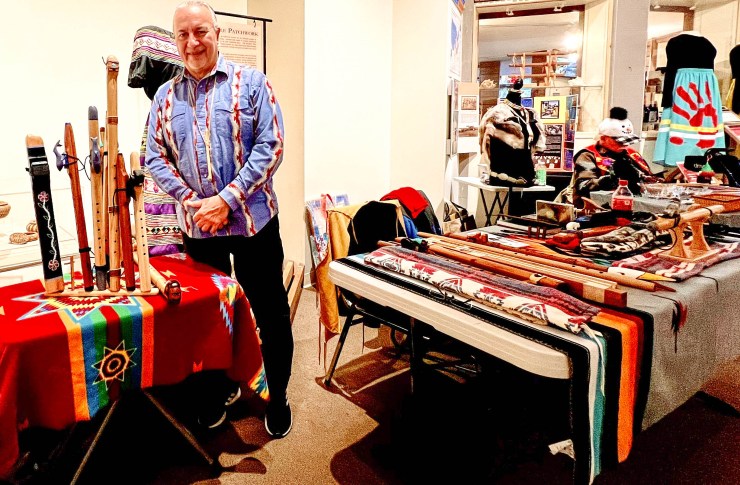
Once again this year, the Institute for American Indian Studies located at 38 Curtis Road in Washington is hosting a one-of a-kind holiday shopping experience that celebrates Native American culture. What makes this Holiday Market unique is that it offers both deeply traditional crafts and more contemporary artistic expressions rooted in Native American cultural experience. Vendors and artists represented here comprise a diverse and inspiring array of artists and experts in handmade crafts.

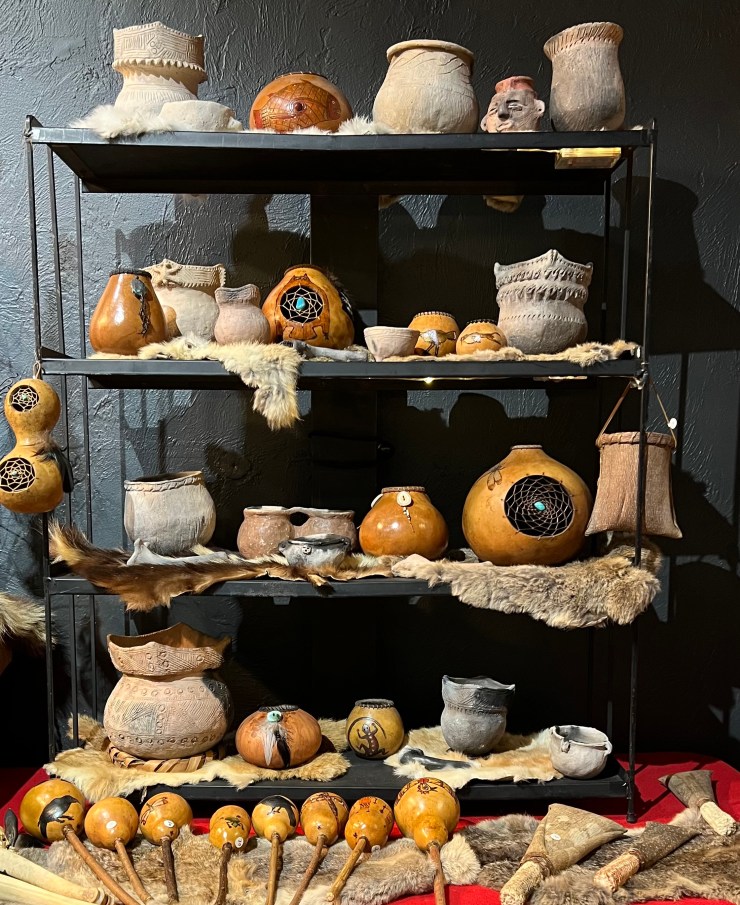
The Holiday Market throughout the Institute’s impressive exhibition galleries takes place on Saturday, December 7 & 14 and Sunday, December 8 & 15, from 11 a.m. to 4 p.m. There are so many gifts to choose from including Native American jewelry, paintings, photography, apparel, and candles, to decorative gourds, pottery, rattles, flutes and more at a variety of price points. The chance to talk with the artists who have created these one-of-a-kind objects and to learn about the culture that inspired them makes your gift purchase even more meaningful.

If you are shopping for pottery and decorative items check out Primitive Technologies that showcase wood fired pottery, decorative masks, and unique jewelry, Jeanne Morningstar Kent (Nulhegan Ban, Coosuk-Abenaki) who creates tribal art on gourds, and Eva Newell, a multi talented artist who offers a range of artwork from beadwork to paintings. For music lovers, Allan Madahbee (Ojibwe) is offering handmade Native American flutes as well as paintings and crafts. Shoran Piper, the Clan Mother of the Golden Paugussett Tribal Nation, is offering a variety of items from lotions and herbs to beaded jewelry, and dream catchers. Keith Rood (Metis) will be selling a beautiful selection of leather bags as well as fans, pottery, and stone blade knives, Eddie Cuevas of Taino Trinkets will be offering an array of handmade items, and Native Visions will be have an excellent selection of contemporary and traditional original paintings, limited edition prints, kachinas, Zuni fetishes and more created by Native American artists and craftsmen from the Plains and Southwest. Some vendors may not be present on certain days, so it is best to call ahead for details 860-868-0518. Also, there may be additional vendors participating that are not listed here.

The Museum’s Gift Shop will be open and brimming with gifts large and small in many price ranges. Here, you will find a distinctive collection of Native American jewelry, including wampum jewelry crafted by regionally located Indigenous artists as well as silver and turquoise jewelry from the Southwest. For foodies, there is a wonderful selection of traditional Native American food products from Sweet Grass Trading Company from the Winnebago Tribe of Nebraska, and others. The gift shop also has a good selection of books and children’s items.

Although entrance to the museum and the Holiday Market is free, donations are always appreciated. A tour of the museum for a nominal fee is a fun and insightful experience that compliments this unique shopping experience.

About The Institute for American Indian Studies
Located on 15 acres of woodland the Institute for American Indian Studies preserves and educates through archeology, research, exhibitions, and programs. They have a 16th c. Algonquian Village, Award-Winning Wigwam Escape, and a museum with temporary and permanent displays of authentic artifacts from prehistory to the present that allows visitors to foster a new understanding of the world and the history and culture of Native Americans. The Institute for American Indian Studies is located on 38 Curtis Road, Washington, CT.

Learn the Cultural Tradition of Corn Husk Weaving @ Institute for American Indian Studies

During this month of gratitude, the Institute for American Indian Studies located at 38 Curtis Road in Washington Connecticut is hosting a Corn Husk Weaving Workshop on Saturday, November 23rd at 1 p.m. Participants will learn the traditional art of weaving beauty from simple cornhusks into a seasonal craft perfect for gift giving.

Originating in South America, corn didn’t reach New England until about 1000 years ago. Corn was a useful crop that wasn’t grown just as a source of food. Many Native American traditions, including the Three Sisters Garden, various traditional stories, and annual ceremonies like the Green Corn Festival, encompass the cultural importance of corn including weaving art and everyday items from cornhusks.

A cornhusk is the outer leaf of the corn plant that protects the cob as it grows. Most of the time, this green outer shell is thrown out after corn is harvested. Readily available during the fall harvest season, skilled Native American artists and other artisans collect the husks and dry them until they turn an attractive shade of golden brown signaling that they are ready to be woven.

At this workshop participants will join an IAIS educator for a hands-on class where they will create crafts made from cornhusks to take home. Weaving with cornhusks has been around for thousands of years in Native American culture and this workshop presents a rare opportunity to experience a bit of Native American culture while creating something beautiful and meaningful.

Pre-registration for this workshop is required and can be made online at iaismuseum.org. The price to participate including all materials, is $20 for non-members and $10 for members of the Institute. If you have questions, please call 860-868-00518 or email events@iaismuseum.org

About the Institute for American Indian Studies

Its “Wigwam Escape” escape room offers an opportunity to solve a puzzle while learning about Indigenous life before European settlement. With a focus on “two-eyed seeing”, visitors can learn about the history of the American continent that incorporates more than 12,000-year history of human habitation. The Institute for American Indian Studies is located at 38 Curtis Road, Washington, Connecticut.

A Morning Ramble to Apple Hill and Cat Swamp @ White Memorial Foundation

Start your day on Saturday, August 31st with a hike up to what Gerri refers to as White Memorial’s “Jewel in the Crown”; Apple Hill. If you want to participate meet at the Apple Hill parking area on East Shore Road at 8 a.m. The hike is free but you must pre-register because this hike is open to 15 participants.

On this walk, keep your eyes peeled for Vultures and Eagles soaring overhead. Then take a stroll down the Laurel Hill Trail to visit the spectacular Cat Swamp. Wind your way through a carpet of Princess Pine to the swamp where sightings of Wood Ducks, otters, herons, beavers, and hawks are commonplace.

photo credit: White Memorial

Be sure to wear sturdy, waterproof shoes. A hiking pole might be useful. Some water and bug spray might come in handy too! To register click here

Learning to Manage Forests to Meet Today’s Needs – The Woodland Academy at Great Mountain Forest Norfolk, Canaan, and Falls Village

People who own and manage woodlands play a vital role in our region because a healthy forest delivers essential benefits for our climate, wildlife, and communities, including recreational and economic opportunities.

To spread the art and science of making sound forest management decisions, Great Mountain Forest (GMF) is launching a Woodland Academy for people who steward forested land on three Saturdays, Aug. 3, Aug. 17, and Sept. 14. GMF is one of Connecticut’s leaders in sustainable forest management, located on 6,000 acres in Norfolk and Canaan. These first Woodland Academy workshops will take place from 8 a.m. to 4:30 p.m. at the Yale Forestry Camp located in the heart of this independent non-profit’s vast forest.

One of the goals of the Woodland Academy is to assist both experienced and new stewards of the land to develop, reevaluate, or enhance their forest management plan to keep their land productive and healthy, now and into the future.

While this program is best suited to landowners and forest managers, such as land trust stewards, GMF welcomes all who love the woods including foresters, environmental advocates, engaged citizens, educators, and students. This workshop’s modules will help participants navigate the evolving woodland landscape they manage amid the challenges of sustainability, invasive pests, and climate change.

The curriculum was created and will be delivered by the foresters at Great Mountain Forest and collaborators from the Connecticut Agricultural Experiment Station and Sharon Audubon. The Woodland Academy is inspired by the Coverts Project previously led by UConn Extension, the Connecticut Forest and Park Association, and CT DEEP. The three modules will cover the ecological underpinnings of land management, how to assess habitat viability for wildlife, show participants how to identify and interpret woody plant species, and review the public management resources and tools of the trade available to manage one’s forest.

“We believe that forest management strategies should be flexible and adaptable over time, meeting the needs of each unique forest, landowner, and community. This workshop will help forest stewards to make the informed decisions needed to achieve their goals” said Michael Zarfos, Ph.D., and Executive Director, Great Mountain Forest.

Pre-registration for each workshop is required. Each seminar is $75 and includes time in the classroom as well as in the field, and lunch. Sign up via the GMF events page: https://greatmountainforest.org/events/

About Great Mountain Forest
Great Mountain Forest (GMF) is a leader in forest stewardship. For more than a century, we have been demonstrating how sustainable management can protect biodiversity and support ecosystems. By serving as a hub for education and research, we are spreading the benefits of sustainable management so that communities across New England derive educational, economic, recreational, and health benefits from their forests—now and well into the future. GMF is a 501(c)(3) nonprofit encompassing 6,200 acres of contiguous forestland in Norfolk, Canaan, and Falls Village Connecticut.

The Power of Storytelling Darlene Kascak, Schaghticoke Tribal Nation Wins Prestigious Spencer Shaw Award

In the age of our impersonal, worldwide, sprawling electronic communication networks, telling and listening to stories, in person, remains a powerful communication tool that is intrinsic to humanity. Telling stories, especially those that are passed down through generations is one of the best ways to build connections and relationships with one another and, with the world around us.

Carol Glynn, education program manager Darlene Kascak receiving award – photo L.E. Agnelli

Award-winning Storyteller, Darlene Kascak, of the Schaghticoke Tribal Nation understands and cherishes the importance of telling stories as a way to keep knowledge and traditions alive. “As a storyteller in Native communities, I bear a profound responsibility. I am entrusted with the task of preserving, protecting, and passing down oral stories that are hundreds, if not thousands, of years old. This role is not just a duty, but also a deep-rooted passion that I hold dear. I am driven by the urgency to keep this tradition alive so that future generations can experience the beauty of learning through storytelling. It is a commitment that I take very seriously.”

In April, Kascak won the prestigious Spencer Shaw Award for Nurturing Education through Professional Storytelling & Storytellers in Connecticut Classrooms & Afterschool Programs for Connecticut Children, from the Connecticut Storytelling Center. This award, named after a famous storyteller, is given to one person annually for their exceptional contributions to storytelling and education. For Kascak, an educator at the Institute for American Indian Studies winning the award was a humbling and gratifying experience because it stands as a testament to the profound significance and value of storytelling in our society. “I am deeply connected to the Connecticut Storytelling Center, not just as a recipient of this prestigious award but also as a member who actively contributes to the organization’s mission of promoting storytelling and cultural exchange. I encourage people to learn the history and stories of their own cultures and share them with their families. It helps them to understand who they are and where they came from, instilling a sense of pride in their ancestors.”

Darlene Kascak – photo L.E. Agnelli

Kasack’s role as an educator at the Institute for American Indian Studies allows her to educate thousands of children about the history of Connecticut’s Indigenous Peoples through their student field trips and outreach programs. Telling the stories not only keeps them alive, they also imparts valuable life lessons to the next generation. “I enjoy telling children’s stories the most because of the lessons they contain within them. “ How Rabbit Got His Long Long Ears,” teaches children how to be kind to those who are different from them. “The Maker of All Things” teaches the consequences of being selfish and demanding and how that affects others. “Why Canines Sniff Each Other’s Tails” and “Turtle Learns to Fly,” teach that everyone is unique and different; we have something special that we are supposed to share with the world. For that gift to come out, we need to be true to ourselves and not try to act like someone we are not. These stories, with their universal themes and engaging narratives, are not just entertaining but also serve as powerful tools for character development and moral education. “

Inspired as a child by her mother’s cousin, Trudie Lamb Richmond, Kascak learned about the beauty of her culture and how to act respectfully with the world. “I heard the stories of the survival of my ancestors who endured rough times and still held onto their beliefs. I watched as she stood up for our people by fighting for causes important to us. I am proud of her work, which included advocating for the inclusion of our history in the Connecticut Education Curriculum. These stories and experiences helped to shape who I am today—a strong, compassionate, and proud Schaghticoke woman.”


About The Institute for American Indian Studies

Located on 15 acres of woodland acres the Institute For American Indian Studies preserves and educates through archeology, research, exhibitions, and programs. They have a 16th c. Algonquian Village, Award-Winning Wigwam Escape, and a museum with temporary and permanent displays of authentic artifacts from prehistory to the present allows visitors to foster a new understanding of the world and the history and culture of Native Americans. The Institute for American Indian Studies is located at 38 Curtis Road, in Washington, Connecticut.

Litchfield Restaurant Week Returns for 2nd Year March 22 – 29

Litchfield Restaurant Week returns for a second delicious year on March 22 – 29 and will feature 20 destinations ranging from bakery cafes and delis to pizza places, gourmet shops, and fine dining establishments.

West Street Grill

Each venue will offer a three-course prix fixe menu at $25, $35, or $45, some for lunch/during the day, others for dinner, and some for both lunch and dinner. See the official Restaurant Week page on the Visit Litchfield CT website (visitlitchfieldct.com) for a full list of participants, their locations, and their website and social media links. Restaurant Week menus will be added to the page in early March.

@ the corner

Litchfield Restaurant Week includes Connecticut’s Chef of the Year for 2023, David DiStasi, and his Materia Ristorante in Bantam, which was named Restaurant of the Year in Litchfield County by the Connecticut Restaurant Association and honored with a 2024 Overall Excellence award from Connecticut Magazine’s dining experts.

Many other participants also earned top awards from Connecticut Magazine’s dining experts, including Best Traditional American for The Village Restaurant, Best New American for West Street Grill, and At the Corner – which also won a Best Beer List award. Petraroia Deli won for Best Deli/Sandwich Shop, and Meraki for Best Lunch, Hidden Gem, and Best Deli/Sandwich Shop.

Litchfield Distillery is also participating in Litchfield Restaurant Week, and last year the craft distillery donated a bottle of its spirits to each participating restaurant that featured a cocktail or food item incorporating those award-winning spirits.

Visit Litchfield CT is the official source of news and updates about Litchfield Restaurant Week, which is sponsored by the Town of Litchfield CT Economic Development Commission.