“Divided Light and Color: American Impressionist Landscapes” AT The Bruce Museum Through Jan. 29

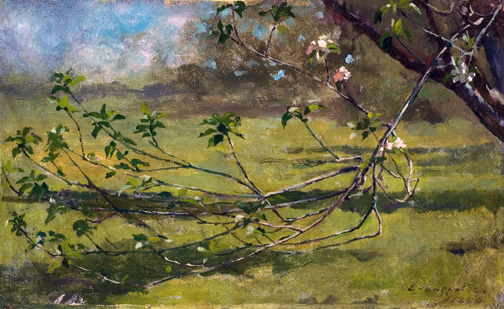
Still among the best loved of all artistic movements, Impressionism records the world with a memorable alacrity, capturing scenes with spontaneous shorthand of divided light and color. The Bruce Museum in Greenwich, Connecticut, presents a new exhibition, “Divided Light and Color: American Impressionist Landscapes” that runs through January 29, 2012.
One of the greatest strengths of the Bruce Museum’s permanent collection and local private collectors’ interests is the American Impressionist landscape. This exhibition brings together two dozen fine examples of impressionist art in a show with imagery that continues to enchant and endure.

Recent acquisitions by The Bruce Museum include examples of the some of the pioneers of American Impressionism, including the distinguished painters, Theodore Robinson (1852-1896), John Henry Twachtman (1853-1902), and Childe Hassam (1859-1935).
Childe Hassam is well represented locally, with outstanding masterpieces recording his time in France and summer art excursions in New England. He is also well known for his work of the local Greenwich scene, including the Holley House, site of the famous Cos Cob Art Colony, as well as Mill Pond and railway bridge in Cos Cob.

The exhibition attests to the importance of the local Cos Cob Art Colony and its founders and instructors, such as Leonard Ochtman (1854-1934), whose house overlooked the Mianus River and whose work is extensively represented at the Bruce Museum. Second generation American Impressionists, such as Elmer Livingston MacRae (1875-1953), Founder of the America Pastel Society and the Greenwich Society of Artists is also represented. A highlight is the work of Matilda Browne (1869-1947), a local resident of Greenwich, and one of the few women artists among the early American Impressionists.


The exponents of American Impressionist landscape painting also recorded American scenery as far afield as New Hope, Pennsylvania and Carmel, California. Uniting these diverse works is a response to changes in light, a strong palette, and the carefully observed atmospheric effects so characteristic of American Impressionism.

This is a beautiful show that should not be missed by lovers of Impressionist Art.

About the Bruce Museum
Consistently voted the “Best Museum” by area media, the Bruce Museum is a regionally based, world-class institution highlighting art, science and natural history in more than a dozen changing exhibitions annually. The Bruce Museum is located at 1 Museum Drive in Greenwich, Connecticut, USA. General admission is $7 for adults, $6 for seniors and students, and free for children under five and Bruce Museum members. Free admission to all on Tuesdays. The Museum is located near Interstate-95, Exit 3, and a short walk from the Greenwich, CT, train station. Museum hours are: Tuesday through Saturday 10 a.m. to 5 p.m., Sunday 1 p.m. to 5 p.m., and closed Mondays and major holidays. Museum exhibition tours are held Fridays at 12:30 p.m. Free, on-site parking is available. For information, call the Bruce Museum at (203) 869-0376, or visit the Bruce Museum website at www.brucemuseum.org.
HawkWatch and Hawkwatch Festival & Green Bazaar at Greenwich Audubon Through Nov. 20

Each autumn, 17 species of hawks, eagles and vultures migrate southwest over Quaker Ridge’s scenic hilltops in northern Greenwich.

The fields are one of the highest locations in town and the sweeping views are an excellent vantage point for spotting birds. On clear days in September when winds are from the North, birders may count a few thousand broad-winged hawks as they swirl in ‘kettles’ before heading South along migration routes.

In the late 1960’s, birders searched Fairfield County for the best sites where large numbers of migrating raptors could be observed. Over several years, more than a dozen sites were tested on weekends and in the end, it was determined that the Quaker Ridge Hawk Watch at Audubon Greenwich, was the best site in the area.

Ever since 1972, migrating hawks have been officially counted as they pass over Quaker Ridge (a.k.a. Hawk Watch Lawn). As part of the network of hawk watch locations nationwide, the Greenwich Audubon Society hired a full-time hawk watcher in 1985.The Official Hawk Counter staffs the site 9:00 am-5:00 pm, Monday-Friday, from August 20-November 20, each year.

On weekends, volunteer counters help to staff the site. Anyone is welcome to volunteer to become a counter at the Audubon’s Hawk Watch. The more eyes the better because the seasonal counts average 18,000 raptors. You don’t need to be able to identify the hawks. Greenwich Audubon simply needs eyes watching the skies! In fact, some of the best spotters are beginners that know very little about identification. Volunteers count and record the data and then, researchers can try to gauge the health of Northeastern raptor populations.

Visitors are encouraged to visit the Greenwich Audubon Center during this exciting time of year and to ask questions, talk with volunteers, and enjoy counting eagles, hawks, and falcons from Hawk Watch Lawn.

For detailed data about raptor sightings at Greenwich, visit http://www.hawkcount.org.

Hawkwatch Festival & Green Bazaar October 1 & 2

Coming up on October 1 & 2, at the peak of the migration spectacle, Greenwich Audubon will host the ‘HawkWatch Weekend Festival & Green Bazaar’ that will feature two days of live birds of prey and animal shows, hands-on nature education, bird workshops, activities for kids, eco-shopping, food, and more! Festival is Rain or Shine from 11 am-5 pm. Admission is $7 for youth/$10 for adults (New or current Audubon Members: $5 for youth / $7 for adults). $35 National Audubon Society family memberships will be available at the Festival Gate.

For more information visit http://greenwich.audubon.org. To learn more about exhibiting or the schedule, call Jeff Cordulack at 203-869-5272 x239.

About the Audubon Center at Audubon Greenwich

The Audubon Center in Greenwich opened in 1942 as the National Audubon Society’s first environmental education center in the United States on land donated by Eleanor Clovis Reese and H. Hall Clovis. The 295-acre sanctuary has approximately seven miles of trails that lead to a hardwood forest, old fields, lake, streams and vernal ponds. Reminders of the past are the stone walks, an old apple orchard and original New England homestead buildings. Audubon Greenwich’s main sanctuary is the site located at 613 Riversville Road, which is comprised of 285 acres, with 7 miles of walking trails. There you will find the Kimberlin Nature Education Center building with exhibits, staff offices and classrooms. The Center contains the Hilfiger Children’s Learning Center with hands-on nature activities and interpretive natural history exhibits, the Kiernan Hall Nature Art Gallery, a Wildlife Viewing Window and honey bee hive exhibit, a Nature Gift Store: books, binoculars, birdfeeders, gifts. The Kimberlin Center is also available for event rentals and children’s parties. Audubon Greenwich is comprised of 11 other sanctuaries totaling 686 acres of woodlands, meadows, and wetlands, and 15 additional miles of hiking trails.