The Bittersweet story of sugar @ Litchfield Historical Society

The Litchfield Historical Society is continuing their series of virtual lectures reexamining fine and decorative art pieces through the human, ecological, and economic impact of the production and distribution of these objects. The second talk in the series will be held on Wednesday, May 12th at 7:00 pm. Brandy Culp, the Richard Koopman Curator of American Decorative Arts at the Wadsworth Atheneum Museum of Art, will be sharing the bitter side of sugar’s history.
 
Packaged_Sugar_with_tableware
 
The Society has a rich collection of objects related to sugar – bowls, boxes, tongs, nippers and more. But where did this sweet treat come from and how did it end up on tables in Litchfield? In her talk, Brandy Culp will share the darker side to Sugar’s past, from its place as a luxury item, to the integral role of slavery in its production and global trade.
 
Brandy Culp is the Richard Koopman Curator of American Decorative Arts at the Wadsworth Atheneum Museum of Art. Before joining the Atheneum, Culp was the curator of Historic Charleston Foundation and the Andrew W. Mellon Fellow in the Department of American Art at the Art Institute of Chicago. She has held positions at the Bard Graduate Center (BGC) and the Metropolitan Museum of Art. 
 

Learn About An Ancient Technology

When people think of Native American hunting tools, bows and arrows are among the first things that spring to mind, and with good reason. Just about every Native American community had some form of a bow and arrow. What many people don’t know is that for thousands of years, many Native Americans used a different type of hunting tool. The atlatl is a dart thrower that allows hunters to throw a dart or spear farther and faster than by hand alone.

atlatiworkshop copy

On Saturday, May 22 the Institute for American Indian Studies in Washington, Connecticut will be hosting an in-person Atlatl Workshop from 12 noon to 2 p.m. and from 2 p.m. to 4 p.m. that will highlight the many uses of this ancient technology, how to make your own atlatl, and how to throw it. Essentially an atlatl is a dart thrower that allows hunters to throw a dart or arrow farther and faster than by hand alone.

If you like to make things with your hands, and throwing sports, don’t miss this intriguing workshop. Participants will learn about the history of the atlatl, one of the first true weapon technologies developed by cultures from all over the world. Different designs of this useful ancient tool that is both a projectile and launching device used by Native Americans will be a highlight. Under the guidance of the Institute’s Educator, Susan Scherf, participants will learn about the different designs of the atlatl before making their own atlatl and dart.

The fun really begins when participants learn how to use their newly made atlatl and seeing how much farther their dart travels. The atlatl session ends with a friendly atlatl throwing competition. If you become an atlatl fan, you might end up competing in atlatl competitions that are held throughout the world!

There are two time slots for this workshop, one at 12 noon to 2 p.m. and the next one is at 2 pm. – 4 p.m. The Atlatl Workshop is $30 for members of the Institute and $40 for non-members and, an adult must accompany participants under 18. To reserve your spot for this fun and educational workshop https://www.iaismuseum.org/event/atlatl-making-workshop-in-person or call 860-868-0518 or email general@iaismuseum.org. Masks and social distancing are required.

About the Atlatl

An atlatl is one of humankind’s first mechanical inventions that preceded the bow and arrow in most parts of the world. Basically, an atlatl is a type of lever that was used to throw a spear farther and faster towards the quarry. The word atlatl comes from the Nahuatl language of the Aztecs who were using them when the Spanish arrived in the 1500s.

According to the World Atlatl Association, early people in the Americas used atlatls to hunt mammoths and mastodons around 11,000 years ago. Much later, a variety of atlatl types were used in different parts of North America. 

Atlatls continued to be used alongside bows and arrows by many Native Americans after the introduction of the bow.

Typically the projectile point or spear point was made of stone such as chert using a process known as flint knapping. The point was attached to a wooden shaft made of hardwood such as ash, hickory, oak, cedar, walnut, or birch.

In time, an atlatl weight was added to the spear thrower as a counter-balance. Weights became more stylized and ornate using fine stone like banded slate to make each piece a unique work of art.

About The Institute for American Indian Studies (IAIS)

Located on 15 woodland acres the IAIS preserves and educates through archeology, research, exhibitions, and programs. We have an outdoor replicated 16th c. Algonkian Village, the award winning Wigwam Escape and a Museum with temporary and permanent displays of authentic artifacts from prehistory to the present that allows visitors to foster a new understanding of the world and the history and culture of Native Americans. The Institute for American Indian Studies is located on 38 Curtis Road in Washington Connecticut.


Mill Days May 22 & 23 Hosted By American Mural Project in Winsted

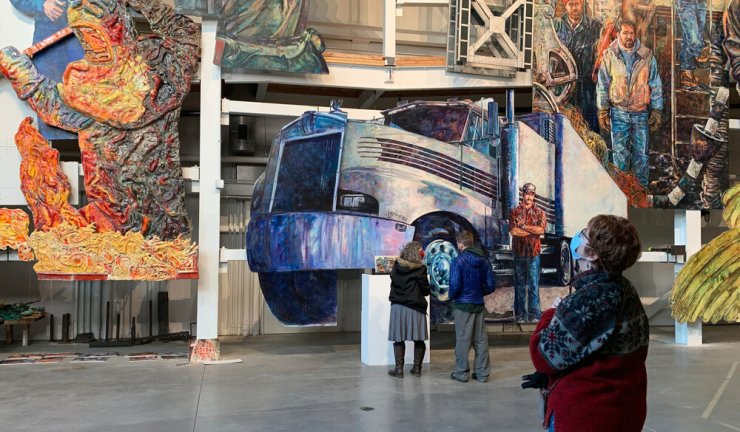
The American Mural Project (AMP) is hosting Open Mill events on Saturday, May 22 and Sunday, May 23 to view the current mural installation progress. Tours are offered at 11a.m. and 12:15 p.m. each day, lasting approximately 45 minutes, at AMP’s location, 90 Whiting Street in Winsted, Connecticut. Pre-registration is required for the tours; limited registrations are available. As AMP is not currently open to the public, these events provide a first-hand sneak peek into the installation process before it is complete, which is anticipated to be in the next eighteen months.

AMP Open Mill Tours

Open Mill visits include an overview of Founder and Artistic Director Ellen Griesedieck’s inspiration for the mural, as well as AMP’s current and future plans for the mural, education programs, and expansion. Through staff-guided tours, visitors will learn about the mural’s tribute to American workers, the people depicted in the mural, and why the subjects were chosen. Tours also provide an opportunity to hear stories about the represented workers and to ask questions. “So much more of the mural has been installed since we had to suspend tours last year,” said Amy Wynn, executive director of the American Mural Project. “Photographs do not do it justice or convey the scale of the work. Seeing the space transformed and the mural in person is the only way to experience the full effect and the artistry unfolding.”

Minimum suggested donation of $10/person is encouraged at the time of registration. As a nonprofit organization readying to open to the public, AMP relies on donations to fund all events and programs.

All health protocols regarding Covid-19 will be followed. All attendees are required to wear a mask while inside the building and maintain at least six feet of distance from other parties attending the tour. AMP merchandise, including one-of-a-kind hand-painted t-shirts and hoodies, will be available for purchase.  

To make a tour reservation or for more information (advance reservations are required; no walk-ups), please visit americanmuralproject.org/open-mill-tours or call 860-379-3006.

As the mural installation progresses, additional Open Mill events will be scheduled throughout 2021.