New at the Beardsley Zoo

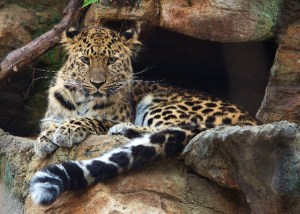
The Beardsley Zoo in Bridgeport Connecticut has new guests this winter. The rare and beautiful Amur leopards are now on exhibit. The pair of Amur leopards we received from the Copenhagen Zoo are now on exhibit. The male can be seen quite often perched on the rock in front of the exhibit. Both are beautiful cats. They hope to receive a breeding recommendation for this endangered species. To make room for this pair, they sent their female Amur leopard, Sofiya, to the Maryland Zoo.
Amur Leopard
Amur Leopard

The new year is bringing new animals to the Zoo. While many of them still need to go through their quarantine procedures or wait for their new exhibits to be completed, this year you will enjoy seeing a male Amur tiger from the Indianapolis Zoo, a male Pygmy marmoset from Fort Wayne Children’s Zoo and a female from Brevard Zoo, a male and female red wolf pair from the Wolf Center, three male vicuna from the Berlin Zoo,and a male and a female giant anteater from Dreher Park Zoo. Beardsley Zoo has also recently received two yellow-spotted turtles, a purple gallinule, three black-bellied whistling ducks and three giant river turtles.

As part of these moves, many made as part of accredited breeding programs for endangered and threatened species, the Zoo removed a male Amur tiger, two male and three female river otters, one male common marmoset, one male pygmy marmoset, and two male and three female red wolves.

This may seem like a lot, but they tend to relocate animals during cooler months when they will be most comfortable, so a lot of movement happens at once.

For more information about the Beardsley Zoo visit http://beardsleyzoo.org and for area information www.visitfairfieldcountyct.com
Curator for a day in Litchfield Hills and more

February is a busy month at the Litchfield History Museum. On February 22 for example, at 3pm a lecture, The Colonial Revival as Collective Memory and Consumer has been scheduled. The lecture will be presented by Thomas Denenberg, director of the Shelburne Museum in Shelburne, VT. The development of a culture of consumption in the decades that bracketed the turn of the twentieth century created unprecedented opportunity for the dissemination of images, objects, and texts that engendered historical consciousness in the United States. Antiquarian activities, the province of social outliers, the wealthy, or the creative such as the painter Edward Lamson Henry (1841-1919), became normative behavior in the new middle-class America.

litchfield  church copy

Gathering, collecting, and sorting historical material culture, once an end unto itself in the nineteenth century, gave way to the creation of a widespread aesthetic that prized idealized “native” forms. Entrepreneurial individuals, including the minister-turned antimodern colporteur Wallace Nutting (1861-1941), employed the very modern platforms of advertising, publishing, department stores, and mail order merchandising to encourage and fulfill middle-class desires for objects and myths that answered contemporary social needs in an era of rapid economic and geographic change.

Often termed “the” Colonial Revival—an aesthetic assumed to be, monolithic, sui generis, and whole upon arrival, this illustrated lecture will look at the phenomenon as a complex and carefully constructed collective memory that matured over time. This program is free for members and $5 for non members. Register at registration@litchfieldhistoricalsociety.org.

If you have ever wondered what it’s really like to be a curator at a history museum, you are invited to shadow the curator of the societies collections on February 26 from 9:30 a.m. – 12:30 p.m. Participants will study artifacts from the Historical Society’s collections, get a behind-the-scenes peek at object storage, a hands-on experience with some of a curator’s day-to-day work, and assemble a hypothetical exhibit. Please register for this program by Tuesday, February 24. Non-members are required to pay the registration fee in advance of the event. Your registration will not be considered complete until we have received payment and the cost is $10 for members; $15 for non-members. Register at registration@litchfieldhistoricalsociety.org.

For more ideas about what to do and see in Litchfield Hills visit www.litchfieldhills.com

Discovering the “New World”: Maps & Sea Charts from the Age of Exploration

There is a time honored fascination with maps and sea charts. The new exhibition at the Bruce Museum is featuring maps to be admired… not for navigation!
This exhibition features more than thirty maps and charts dated between 1511 and the 1757. The maps — woodcuts or metal-plate engravings, many with original hand-applied color — represent Renaissance-period attempts by European ateliers to edify their clientele by revealing our “new” hemisphere and its approaches, as discoveries and claims came ashore from those daring enough to pack their sea bags and head for the unknown.

Today, we live in routine harmony, with cartography: on television and the Web; in newspapers, books and magazines. Satellite maps signify weather; detail maps illustrate locales of crucial events; GPS screens send us, often correctly, to new locales. On land, at sea, and in the air—digitized geography helps deliver goods and people everywhere, often without human intervention.

It was not always so. More than five hundred years ago, two European empires began daringly (and competitively) seeking the most efficient seaborne routes to the riches of Arabia and The Orient—Spain sailing west; Portugal sailing east. Mapmakers back home (nearly all landlubbers happy to sit by the fire) scrambled to gather the latest explorers’ reports to enable them to draw up-to-date maps, print them as separate sheets, and sell them largely to the wealthy as bound atlases—massive compendia that glorified leather-filled libraries and enriched cultural reputations.

But much of the news sent home was erroneous, owing to imperfect navigation, honest misreadings of reality, or deliberate misrepresentations. (As he wandered around the Caribbean Sea, for example, Columbus believed he had found India.) Altogether, these factors make historic “New World” maps a fascinating study in geographic and human progress—and occasional regression.

The Bruce Museum is open Tuesday – Sunday 10 am – 5 pm, Doors close 1/2 hour before closing, and the last admission is at 4:30 pm. For additional information call 203-869-0376 or visit https://brucemuseum.org.

For area information www.visitfairfieldcountyct.com
February at the Ridgefield Theatre

The Ridgefield Theater located on 109 Danbury Road in Ridgefield has planned a series of exciting shows in February sure to chase away the winter blues.

RidgefieldPlayhouse_Photo1

On Valentine’s Day weekend, Living Colour will perform on Feb. 13 at 8 pm. Living Colour took home their first of several Grammy Awards, as “Cult” won Best Hard Rock Performance at the 1989 ceremony. During the 1980s, rock had become completely segregated and predictable, the opposite of the late ’60s/early ’70s, when such musically and ethnically varied artists as Jimi Hendrix, Sly & the Family Stone, and Santana ruled the Earth. But bands such as New York’s Living Colour helped break down the doors by the end of the ’80s, leading to a much more open-minded musical landscape that would eventually pave the way for future bands.

Chris Botti takes the stage on Feb. 14 for a Valentine’s Day Gala that will include raffle prizes such as jewelry courtesy of Addessi Jewelers, Driver for an evening with dinner and Playhouse concert tickets courtesy of BMW of Ridgefield and a year of beauty courtesy of Adam Broderick Salon & Spa. Chris Botti, earned so many superlatives in his career, it may be best to put it simply: the cat can play. Trumpeter Chris Botti brings his superb musicianship, his killer band and his on-stage generosity to The Playhouse stage for one night of can’t-miss musical thrills.

In 2013, Botti won the Grammy Award in the Best Pop Instrumental Album category. He was also nominated in 2008 for his album Italia, and received three nominations in 2010 for the live album Chris Botti In Boston. Four of his albums have reached the No. 1 position on the Billboard jazz albums chart.Moving effortlessly from jazz to pop and in between – Chris Botti may spend more than 300 days on the road every year, but every concert is special!

For kids, there will be a performance on Feb. 21 at 11 am and 2 pm of The Little Engine that Could. Based on the classic book by Watty Piper. Little Blue Engine dreams of someday leaving the train yard to pull the big cars on the main line track. But can she convince Big Silver that she is worthy of being a main line engine? Back to reprise its sold-out premiere season, ArtsPower’s dynamic, song-filled adventure portrays Watty Piper’s timeless tale about hard work, determination, and the meaning of true friendship.

Comedy rounds out the month with a performance on Feb. 28 at 8 pm by Paula Poundstone. Over the span of her remarkable career, Paula Poundstone has amassed a list of awards and accolades that stretch the length of a great big tall guy’s arm. Poundstone is recognized as one of Comedy Central’s 100 Greatest Stand-ups of All Time and has won an American Comedy Award for Best Female Standup Comic. In 2010, Poundstone was one of a select group voted into the Comedy Hall of Fame. As a member of NPR’s Wait Wait… Don’t Tell Me, she is now heard in 5 million homes across the country as she matches wits with some of the country’s leading pundits.
For ticket information: http://ridgefieldplayhouse.org

February Fun at Beardsley Zoo

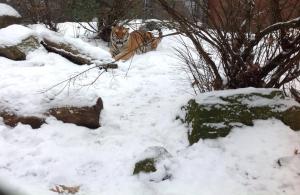
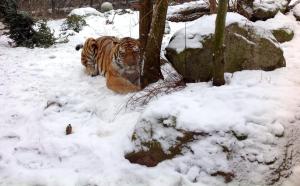
There is a new big cat exhibit at the Beardsley Zoo this winter. Petya, an 8 year old Amur Tiger recently joined the Zoo from the Indianapolis Zoo. Amur tigers are an endangered species, and we participate in the Association of Zoos and Aquariums’ Species Survival Program for these animals. Petya joins Naka, the Beardsley Zoo’s 9-year-old female Amur tiger. It is refreshing and fun to watch Petya play in the snow.

10410549_10205234517677890_2856579275860127101_n

On February 14 in honor of Valentine’s Day, the Beardsley Zoo is offering a 15% discount on admission to everyone that is wearing red, a sweet deal indeed.

The annual Asian New Year Festival is taking place at the Zoo at 12 noon on February 21. Come and celebrate the Year of the Sheep and check out the Zoo’s goats while you are visiting! There will be special stories, crafts, a children’s parade and many more fun activities. The snow date is Feb. 28.

10947213_10205234517557887_2862558946763426260_n

For more information about the Beardsley Zoo located on 1875 Noble Ave in Bridgeport, visit www.beardsleyzoo.org. For area event information www.visitfairfieldcountyct.com.

Rick Shaefer Draws the Line at Housatonic Museum of Art

The Housatonic Museum of Art presents Rick Shaefer: Drawing the Line on view in the Burt Chernow Galleries, 900 Lafayette Blvd., Bridgeport, CT, from February 12 through March 27, 2015 with a reception open to the public on February 12 from 5:30-7:00 pm. The Burt Chernow Galleries are free and open seven days a week. Visit the website, www.HousatonicMuseum.org for gallery hours.

LIVE OAKS

Drawing is essential to the training of an artist. It is the most direct medium between the artist and his observations, thoughts, feelings and experiences—serving both as a record and as a revealer of truth. Drawing is both a cognitive and manual process that provides the foundation for painting, sculpture and architecture. Fairfield artist Rick Shaefer’s monumental, breath-taking drawings offer viewers an adventure in looking with his technically precise and visually poetic drawings of animals and nature.

At first glance, it is clear that Shaefer has more than a passing acquaintance with works of art across time. Of all the masters he has studied, it is Albrecht Durer that has influenced him most. In the 16th century, the natural world of animals and plants had become the focus of scientific and cultural interest as explorers returned from far-flung places carrying examples and illustrations of exotic new species. One of Durer’s best known pen drawings, Rhinoceros, 1515, demonstrates the artist’s fascination with recording the curiosities and wonders of the world. Paradoxically, Shaefer’s own African Rhinoceros, beautifully rendered in rich charcoal on vellum, comes full circle by documenting what now may be the waning days of these magnificent beasts.

BELGIAN BLUE

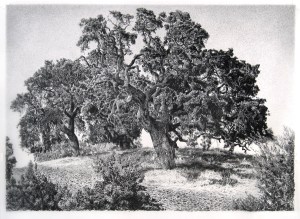
Shaefer’s trees, crowned with leaves or barren and in varying states of decay, are densely detailed and sensitively modeled through the use of tonal gradations. Majestic oaks and tangled vines allow the artist to mine the sculptural properties of a charcoal line, expressing not only what he observes but how he feels. A dramatic narrative unfolds before the eye, compelling the viewer to travel along through the light and into the shadows.

And, like the rhinoceros, these powerful and confident drawings circle around a common theme: the effects of human activity on nature. Climate change specifically could lead to the massive destruction of forests as well as the extinction of countless species. Global warming has led to the increase of forest fires as well as a proliferation of pests and diseases. Rick Shaefer: Drawing the Line looks to the rich tradition of drawing in order to explore the critical issues of our time.

For area event information www.visitfairfieldcountyct.com